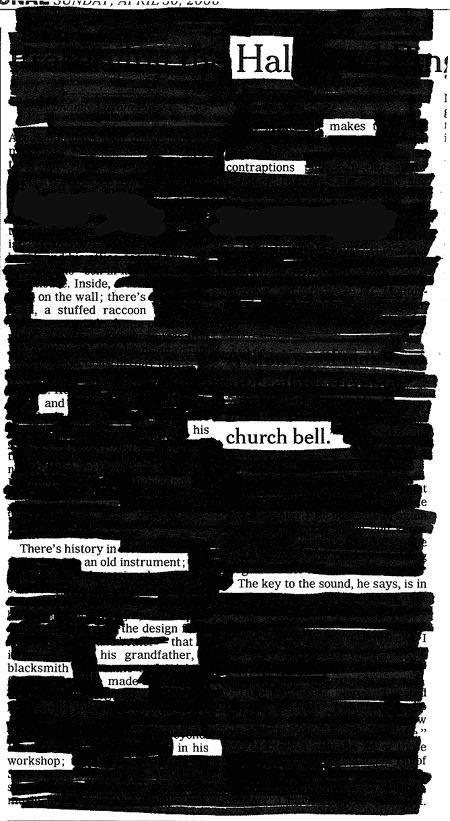
An old blackout poem pulled out of a notebook…
An old blackout poem pulled out of a notebook…
I’m trying to make this thing as much like a virtual sketchbook/scrapbook/notebook as I can, and avoid the regular trappings of blogging, like long link rolls and book reviews. (Even though I like those trappings on other blogs.) However, if you want that stuff, check out the del.icio.us and LibraryThing feeds on the sidebar.
I’m going to teach myself color. It’s something I’ve never understood, and something I’ve never really been able to do. I’m sure that somewhere I have a subconscious understanding of it, but I just can’t consciously create effects using it. I suppose the solution is getting out a big box of crayons and starting to play, but I’ve been putting it off.
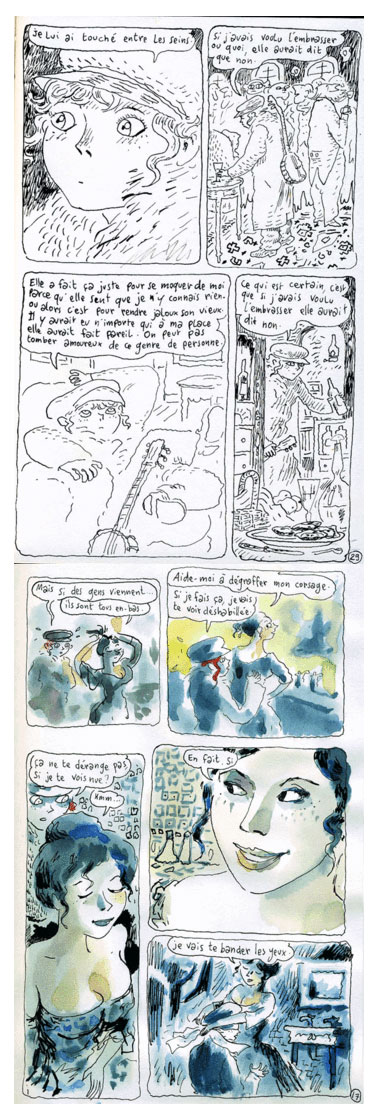
Last night I was reading Joann Sfar’s Klezmer, Book One. He is brilliant: he doesn’t plan anything when he writes it, he just cuts loose and lets the story dictate where it goes. His line is so free and sketchy, he just knocks the thing out. (This is why he has more than 100 books to his name.) He sent The Rabbi’s Cat to a colorist, but for this one, i think he did his own color (at least I couldn’t find a credit for another colorist.)
Look at the way his drawings are transformed by color:
I keep wanting Meg to teach me, because she’s a master of color, but we’re so busy that I don’t see it happening any time soon.
So I turn to books. Right now, it’s Josef Albers’ Interaction of Color. Page 8:
On the blackboard and in our notebooks we write: Color is the most relative medium in art.
The book’s aim is to show that colors work only against other colors, and that pleasing effects arise out of these juxtapositions. (When Meghan was learning to paint, her teacher would only let her use color — no blacks, no whites!) This was a big slap in the forehead for me, because my only foray into color has been to use it to accent black and white drawings. Albers uses several examples with colored paper to show different effects:
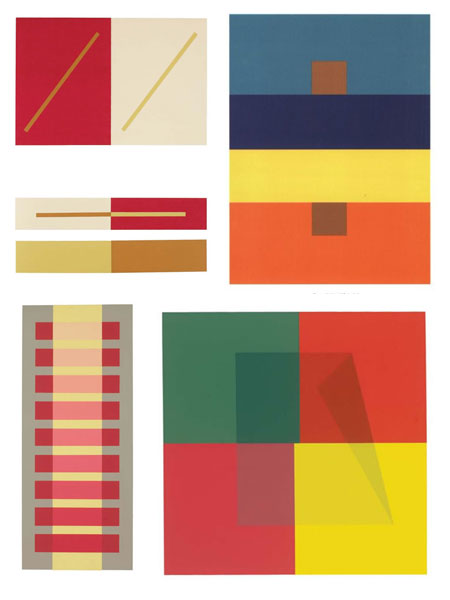
Meghan did a series of collages last year that were very similar to these paper confections: strips of pure color that she was arranging into these really cool landscapes. I can’t find a scan of them anywhere right now. Maybe I’ll post them later.
Either way: look out color, here I come.
I’ve been thinking lately about paper.
After the Great Powerbook Crash of ’06, I’m growing ever more skeptical of digital media. Even though I do a great deal of my drawing on the computer, I’m rediscovering the joy and permanence of filling notebooks.
And ever since we had to cancel our subscription to the New York Times, it’s been a real treat to head over to the future parents-in-law’s to dirty up my fingers with newsprint.
* * *
What else got me thinking about paper?
Cartoonist Kevin Huizenga (who has a new book coming out soon) had a great post a few days ago about Bill Blackbeard, the history of archiving Krazy Kat strips, and Nicholson Baker’s Double Fold. Here’s the jacket copy from Double Fold:
Since the 1950s, our country’s libraries have followed a policy of “destroying to preserve”: They have methodically dismantled their collections of original bound newspapers, cut up hundreds of thousands of so-called brittle books, and replaced them with microfilmed copies — copies that are difficult to read, lack all the color and quality of the original paper and illustrations, and deteriorate with age. Half a century on, the results of this policy are jarringly apparent: There are no longer any complete editions remaining of most of America’s great newspapers. The loss to historians and future generations is inestimable.
In my brief tenure working in a public library, I’ve witnessed this depressing phenomenon first-hand. Due to budget restrictions, libraries are increasingly being run as retail chains (like everything else in this country, the pull towards privatization is strong), and so, in a bid for more space, the mantra is if you can get it online, drop the paper copies (so we can make room to put in more computers for tax payers to check e-mail and look at porn.)
The problem is, the majority of online references include no layout or graphics. So yes, you can read that Plain Dealer article from 5 years ago, but you won’t see any photography or the graphics that went with it. (Some databases, like the New York Times Historical Database or say, The Complete New Yorker, remedy this problem beautifully by using PDF technology.)
The only reason Krazy Kat survived this coup was through the efforts of a dedicated fan who clipped each and every color strip and donated his run to a historical society in Wisconsin.
Otherwise, the strips would be rotting in a dumpster somewhere.
* * *
Cool fact: 2 hours away, the Cartoon Research Library at Ohio State has six tractor-trailers worth of old newspapers that Bill Blackbeard sold to the university.
I’m researching a good deal of The Book through microfilm, and therefore, spending a lot of time squinting.
The nice thing about paper? It’s ridiculously high-resolution. No squinting required. And you can stick it in a big file folder to sift through later.
Edward Tufte, in his brilliant tirades against PowerPoint, has repeatedly championed this triumph over digital media:
Overhead projectors and PowerPoint tend to leave no traces; instead give people paper, which they can read, take away, show others, make copies, and come back to you in a month and say “Didn’t you say this last month? It’s right here in your handout.” The resolution of paper (being read by people in the audience) must be ten times the resolution of talk talk talk or reading aloud from bullet lists projected up on the wall. A paper record tells your audience that you are serious, responsible, exact, credible. For deep analysis of evidence and reasoning about complex matters, permanent high-resolution displays are an excellent start.
So yeah. Let’s hear it for paper!

Somewhere in the past two months I’ve lost the joy of waking up in the morning, and, to paraphrase Donald Barthelme and Lynda Barry, not-knowing. Everything seems forced and planned, and spontaneity is dead, just like the work.
No more! I say. Time to get back to the good stuff. Time to play.
I pulled out my Good Books last night, my James Kochalka and my Lynda Barry, and afterwards just started doodling in my notebook, trying to get back to that state.
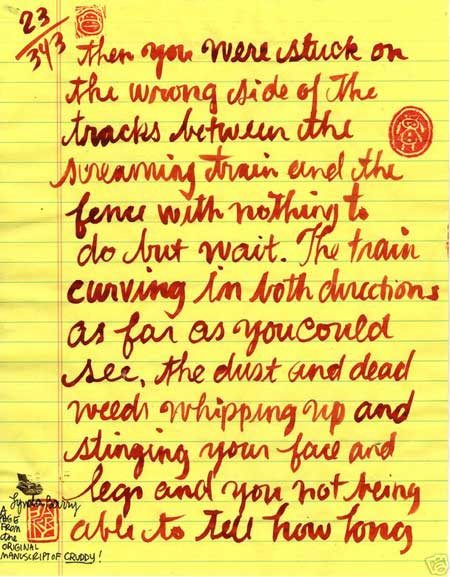
Then this morning, I was checking up on Lynda, and in addition to a new page from WHAT IT IS, I came across this magical artifact up for auction her ebay account:
That’s right! An original manuscript page of CRUDDY. As Lydna says, (and I know I’ve quoted this before):
I tried not to think about the book unless I was actually writing it and I tend to write in the first person, in the character of someone, and that someone was Roberta….My goal was to not think about things at all. To dream it out instead, trying very hard not to edit at all as I went. The first draft really took shape when I found that I needed to slow way down and distract myself at the same time so I used a paintbrush and Tuscan red watercolor and painted the manuscript on legal paper, trying to concentrate on the calligraphic aspect of writing rather than trying to craft beautiful sentences. I figured as long as the sentences looked beautiful, the rest would take care of itself. That draft was seven hundred pages long. I used a hairdryer when I got to the end of each page so I could stack them without smearing. I can do some pretty nice handwriting now. I tried to write it a word at a time like it was being dictated. Cruddy was the result.”
Genius. Check out her interview on Talk of the Nation.
Now back to work play!
This site participates in the Amazon Affiliates program, the proceeds of which keep it free for anyone to read.