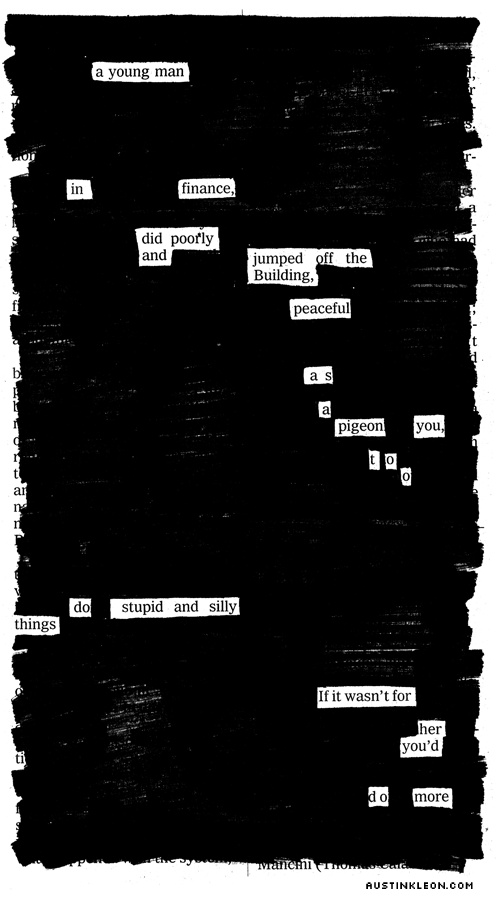
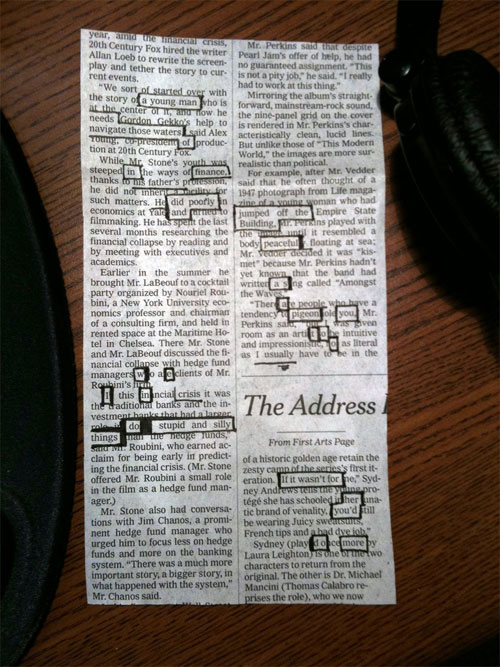


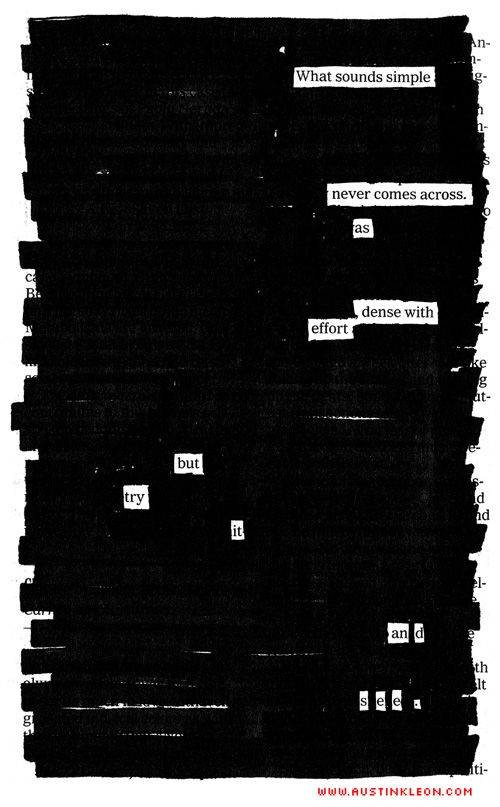
MODERN ART = I COULD DO THAT + YEAH, BUT YOU DIDN’T—“Modern Art” from More New Math by Craig Damrauer
It’s said in different sentences.
“An idea so simple I can’t believe nobody thought of it before.”
“I could’ve done that.”
“Any idiot could do that.”
“I’m sure you’re not the first person to put Sharpie to newspaper.”
(That last one came from a trollish e-mail I got last week.)
If you have a good idea and it’s well-executed, it looks effortless. It looks like it’s been around forever.
But I don’t want it to look effortless! you say. I want it to look as hard as I worked on it.
No, you don’t. You want it to look easy.
Bob Gill says it best, in Graphic Design As A Second Language:
There’s nothing more embarrassing than a juggler who always looks as if he’s about to drop whatever he’s juggling.
By my standards, however difficult it is to make art, it should always look easy, never labored. That’s what I mean by inevitable.
After the curtain came down on a Paddy Chayefsky play, the person sitting next to me got up and complained to his wife, “what’s the big deal? I cudda written that.”
I assumed that what he meant, was that he was not aware of anything the playwright actually did. It was as if the playwright simply pressed the on button of a tape recorder, so that the characters in the play were so convincing, was its strength.
This is what I try for. I like the idea that if I’m successful, the guy who sat next to me that night, would have the same reaction to my work, as he did with Chayefsky’s.
But perhaps the reason ideas seem “inevitable” is because they are:
Every idea is a juxtaposition. That’s it. A juxtaposition of existing concepts. —Steven Grant
The idea maker is a collage artist. You put two ideas together, and you get a third new one.
The trick, as Grant writes, is to fill your head with many ideas (reading is the best way to do this), and keep the ones that appeal to you.
Select only things to steal from that speak directly to your soul. If you do this, your work (and theft) will be authentic.—Jim Jarmusch
The next step is to put them up against each other—to find patterns. The third and final step is to do create your collage, to fuse the ideas so seemlessly that it seems effortless.
Immature poets imitate; mature poets steal; bad poets deface what they take, and good poets make it into something better, or at least something different. The good poet welds his theft into a whole of feeling which is unique, utterly different from that from which it was torn; the bad poet throws it into something which has no cohesion. A good poet will usually borrow from authors remote in time, or alien in language, or diverse in interest.— T.S. Eliot, 1920, The Sacred Wood
Of course, sometimes you don’t need a good idea. Sometimes the only thing you have to do is give an existing idea a good name (“an idea is gold / only if you name it“):
It was an idea that was already out there, but I shined a spotlight on it, named it, and everybody got it right away.— Sam Martin
It’s all very much like making a blackout poem, actually: you sift through words, pick the ones you like, find the pattern of words that work good together, and blackout the rest into one coherent piece.
If you did it well, it looks easy.
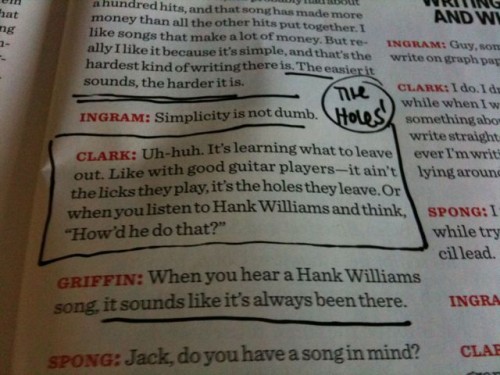
The above snippet came from a Texas Monthly article on Texas songwriters I read on the plane this morning.
It reminded me of Ronald Johnson, in his introduction to radi os, a long poem made by erasing words from Milton’s Paradise Lost: “I composed the holes.” (Johnson was quoting a composer whose name I forget at the moment.)
Composing the holes. That’s what we do when we craft a piece of art, whether it’s drawing or making a blackout poem.
It’s often the holes in pieces of art that make them interesting. What isn’t shown vs. what is.
The same could be said of people. What makes them interesting isn’t just what they’ve experienced, but what they haven’t experienced.
Devoting yourself to something means shutting out other things.
When it comes to education, it’s not just the holes, but the order you fill them in. For instance, if you read the canon straight through, from Homer to McCarthy (or whoever), how original would the connections in your mind be? Better to start with one author you love, who speaks to you, and move in every direction, backwards, forwards, sideways…the juxtapositions you see and the connections you make in your brain will be more unique.
The same is true when you make art: you must embrace your limitations and keep moving.
Compose your holes.
(Written on my iPhone in the Houston airport.)
The content of this interview I did with Nate Burgos over at Design Feaster might be familiar to anyone who’s read my posts about blogging before, but you might want to take a look anyways.
On why I started a blog:
When you’re a writer in college, you have the ultimate luxury: a captive audience. Your teachers get paid to read your writing and your classmates pay to read your writing. And then, suddenly, you get out of college, and nobody gives a crap anymore. So you start a blog!
On my hatred of computers:
This might be blasphemous for a blogger to say, but I don’t like spending more time in front of a computer screen than I have to. The good stuff comes from your hands and your head. (The cartoonist Lynda Barry says, “In the digital age, don’t forget to use your digits!” A blog is just a delivery system—a way to get eyeballs looking at your stuff (and minds thinking about it).
Making lithographs of a Newspaper Blackout Poem from Austin Kleon on Vimeo.
More footage from our printmaking extravaganza last weekend in San Marcos. This time, it’s Clif Riley making lithograph prints of “Visual Thinking.”
This site participates in the Amazon Affiliates program, the proceeds of which keep it free for anyone to read.