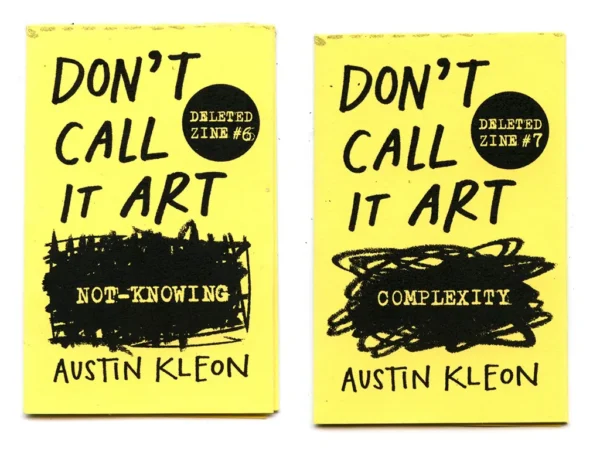
I can’t stop making zines! Issues #6 and #7 of my Deleted Zines from Don’t Call It Art are available for free in today’s newsletter.
I can’t stop making zines! Issues #6 and #7 of my Deleted Zines from Don’t Call It Art are available for free in today’s newsletter.
The physicist Carlo Rovelli has a beautiful way of talking about science in terms of ignorance and curiosity.
In Helgoland: Making Sense of the Quantum Revolution, he writes:
I believe that one of the greatest mistakes made by human beings is to want certainties when trying to understand something. The search for knowledge is not nourished by certainty: it is nourished by a radical absence of certainty. Thanks to the acute awareness of our ignorance, we are open to doubt and can continue to learn and to learn better. This has always been the strength of scientific thinking—thinking born of curiosity, revolt, change.
He wrote almost the same thing almost two decades earlier, in his book The First Scientist: Anaximander and His Legacy:
Science, I believe is a passionate search for always newer ways to conceive the world. Its strength lies not in the certainties it reaches but in a radical awareness of the vastness of our ignorance. This awareness allows us to keep questioning our own knowledge, and, thus, to continue learning. Therefore the scientific quest for knowledge is not nourished by certainty, it is nourished by a radical lack of certainty. Its way is fluid, capable of continuous evolution, and has immense strength and a subtle magic. It is able to overthrow the order of things and reconceive the world time and again.
I think he could also be talking about art.
Filed under: not knowing
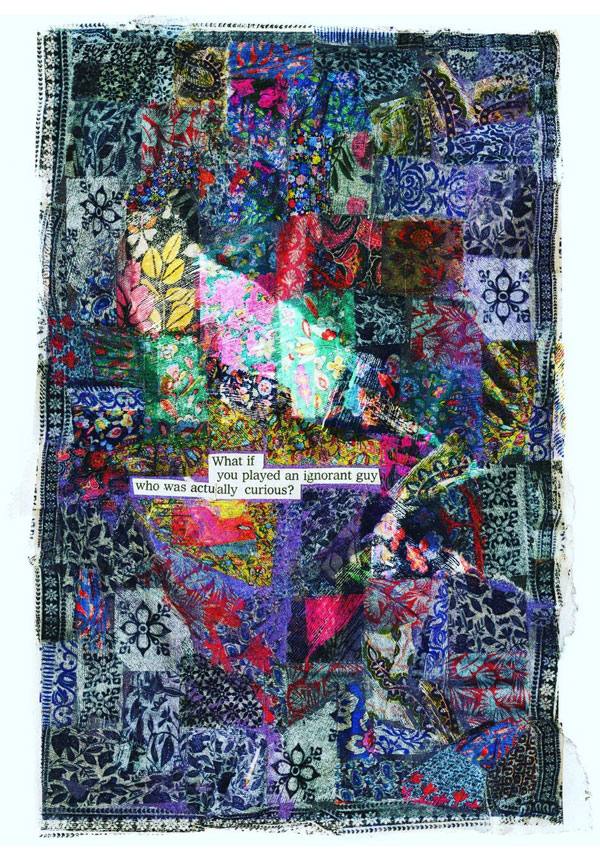
“What if you played an ignorant guy who was actually curious?” is how the actor Jason Sudeikis explains his approach to his character, Ted Lasso.1
It’s a method of acting, but it could be a method of life. (A method we’ve covered before: “Teach your tongue to say I don’t know” and “learn to play the fool.”)
The method is perhaps best summarized by Mike Monteiro: “The secret to being good at anything is to approach it like a curious idiot, rather than a know-it-all genius.”
* * *
The “curious idiot” approach can serve you well if you can quiet your ego long enough to perform it.
A curious idiot is unafraid to ask stupid questions. Every stupid question you ask takes a teeny, tiny act of courage. Sometimes you have to muster the will to push the words out of your lips.
I’m currently at the tail end of one of the worst projects I’ve ever been involved in, and several failure points probably could’ve been avoided if I’d have had the guts to stuck my nose where it didn’t belong and ask the contractors stupid questions until I was satisfied with their answers.
I got so angry about it last week that I posted this tweet thread:
Lesson I have learned the hard way over the years: when working w/ a contractor or collaborating on a project, if you see a potential snag or just a nagging doubt DEAR GOD BRING IT UP and ASK QUESTIONS about how specific things will work. Do not assume anyone has it covered.
I have been burned so many times over the years imagining the worst that could happen at a specific step in a project, not saying it out loud, and then that thing, in fact, does happen. Don’t think, “Oh, I’m just a worrywart, it’ll be fine.” Trust the voice in your head!
Especially when you are working with “experts,” like, electricians or builders or designers or tech teams or whatever — ask them the stupid, obvious questions. The expert constantly misses things the outside observer catches, exactly because they’re not an expert.
If an expert dismisses your stupid question or doesn’t answer it in a way that’s acceptable to you, that is a huge red flag. You should either a) keep on them and ask them more questions b) find a new partner.
Hope for the best, prepare for the worst, always — and if it’s your project, and your ass that’s on the line, remember that nobody cares as much as you do, and nobody is paying as much attention as you are (care is a high form of attention)
That last point might be the most important: care is a form of attention, and unlike talent or expertise, it can be willed into being at any time.
If you care more than everybody else, you pay better attention, and you see things that others don’t see. To ask the questions that need to be asked, you have to care more than others about what happens, but care less about what others might think of you in the moment.
“Teach us to care and not to care,” wrote T.S. Eliot in “Ash Wednesday.”
Or, as Karen McGrane put it so wonderfully and vulgarly, “Give a crap. Don’t give a f***.”
* * *
Footnotes
Mary Ruefle, in a wonderful conversation with David Naimon:
I would rather wonder than know. It makes it more and more difficult to be alive on earth in these times, when your inclination is to wonder rather than to know.
I suppose the example that comes to mind is: it used to be if you were having dinner with people and someone said, “Who’s the fastest animal on earth?” An amazing conversation would ensue. And now someone pops their phone out and looks up the answer. And it breaks my heart….
I really, really don’t like it when people look things up on their iPhones…. I mean, sometimes, of course, I’m no idiot. The encyclopedic nature of the information that’s available is fantastic, but I would still rather wonder than know.
I think wondering is a way of inhabiting and lingering. There seems to be more dwelling. To dwell, inhabit, and linger. I’m interested in those things. And you can do that when you don’t know.
We tend to, as human beings, our impulse is, once we know, once we have the answer, we move on. So we’re constantly moving from one thing to the other. I would rather inhabit the question, or dwell. For me, that is the place I want to live in.
I have an encyclopedia at home. It never occurred to me there was ever anything wrong with it until my friend pointed out it was an Encyclopedia Brittanica from 1910 and it might be a little outdated. I still look things up in it! […]
My oldest son used to ask me questions and when I said I didn’t know the answer, he’d say, “Look it up on the Goggle!” It takes discipline, now, not to look things up immediately, but to sit and wonder…
Then again, when you do look things up, you find more things to wonder about.
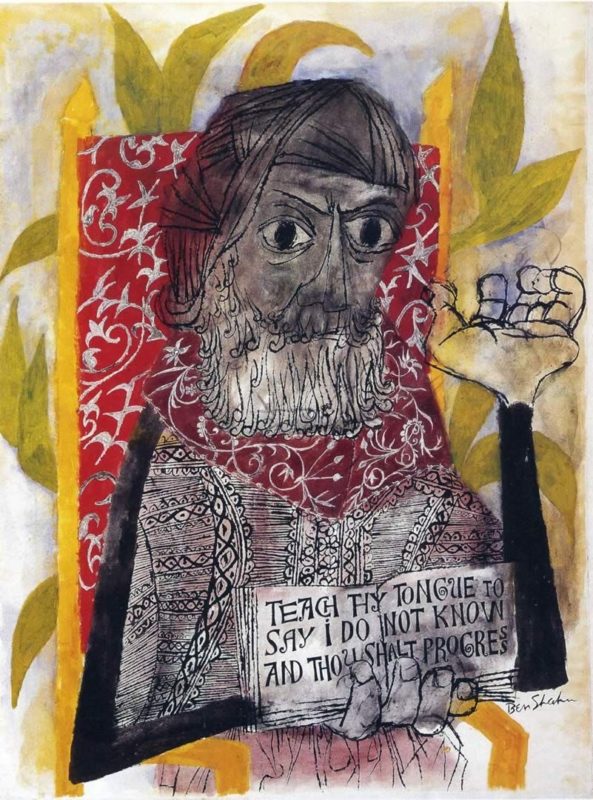
Here is Ben Shahn’s Maimonides, painted in 1954. “Teach thy tongue to say I do not know and thou shalt progress.”
I’ve long believed that “not-knowing” is the proper mental state for making art, but I’m starting to think it’s the proper mental state for going about life in general. (As Mike Monteiro says, “The secret to being good at anything is to approach it like a curious idiot, rather than a know-it-all genius.”)
“Whatever inspiration is, it’s born from a continuous ‘I don’t know,’” said the poet Wislawa Szymborska in her 1996 Nobel Prize lecture. She spoke of why she values “that little phrase ‘I don’t know’ so highly”:
It’s small, but it flies on mighty wings. It expands our lives to include the spaces within us as well as those outer expanses in which our tiny Earth hangs suspended. If Isaac Newton had never said to himself “I don’t know,” the apples in his little orchard might have dropped to the ground like hailstones and at best he would have stooped to pick them up and gobble them with gusto. Had my compatriot Marie Sklodowska-Curie never said to herself “I don’t know”, she probably would have wound up teaching chemistry at some private high school for young ladies from good families, and would have ended her days performing this otherwise perfectly respectable job. But she kept on saying “I don’t know,” and these words led her, not just once but twice, to Stockholm, where restless, questing spirits are occasionally rewarded with the Nobel Prize….
Szymborska said that inspiration was not just the domain of poets and artists, but people in all sorts of work — work that “ becomes one continuous adventure as long as they manage to keep discovering new challenges in it.” Their curiosity is never quelled, and “[a] swarm of new questions emerges from every problem they solve.”
Here is how the actor Philip Seymour Hoffman described getting into the role of Truman Capote:
I think you have to kind of start with saying, “I don’t know. I don’t know how the hell I’m going to do this at all.” Really be as naive as possible, you know, as ignorant as possible, because then you can keep yourself as wide open as possible for anything that could be of help, could be of use…
“Naiveté,” is the title of the penultimate chapter of Gareth Matthews’ Philosophy and the Young Child, and in which he writes, “An adolescent or adult who writes poetry or does philosophy has to cultivate innocence to be able to puzzle and muse over the simplest ways of saying and seeing things.”
There’s a big connection between philosophy, wonder, and puzzlement. Wittgenstein: “A philosophical problem has the form: ‘I don’t know my way about.’”
I think this “puzzlement” is in good art, too. The artist, like the philosopher, is exploring what she doesn’t know.
Bertrand Russell said of philosophy,
“if it cannot answer so many questions as we could wish, has at least the power of asking questions which increase the interest of the world, and show the strangeness and wonder lying just below the surface even in the commonest things of daily life.”
Sounds like art to me!
This is, again, why I rail against being called an “expert” or a “guru”: the minute you think you know everything — or anything, really — you’re out of that state that leads to good creative work. The more time you spend giving people answers, the less time you spend asking questions.
 Here’s Matthews on why we should make room in our lives for philosophy, or what Robert Spaemann calls “institutionalized naiveté”:
Sophistication may bring increased knowledge and, perhaps, a refined sensibility. But it may also encourage a cult of experts, dull sensitivity, and may reward flatulence in thought and language. Every society needs a barefoot Socrates to ask childishly simple (and childishly difficult!) questions, to force its members to reexamine what they have been thoughtlessly taking for granted.
“[A] cult of experts, dull sensitivity, and… flatulence in thought and language.” Sounds like a conference of “thought leaders”!
More about the importance of not-knowing and uncertainty in chapter seven of my latest, Keep Going.
(Thanks to @seekandspeak for sending me Szymborska’s Nobel lecture.)
This site participates in the Amazon Affiliates program, the proceeds of which keep it free for anyone to read.