notes scribbled in the dark
Usually when I visit foreign cities and I’m feeling bewildered, I get the feeling that if I knew a local—if I only knew the inside scoop—then all these hidden treasures would be at my fingertips, and the city would open up and present itself as a sparkling gem of culture and fun.
I didn’t get that feeling in Akron. I got the feeling that what you see is what you get.
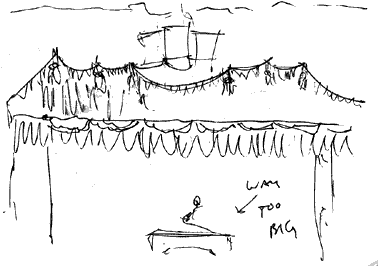
We headed down to the Blimp City Saturday night to see David Sedaris at the unique Akron Civic Theatre, which was built in 1929 and “fashioned after a Moorish castle featuring Mediterranean decor, including medieval carvings, authentic European antiques and Italian alabaster sculptures.” It’s one of the only remaining “atmospheric theaters” in the country, with “a twinkling star-lit sky and intermittent clouds moving across the horizon.”
During the preliminary book signing, Sedaris had asked two teenage girls who had driven in from Ann Arbor to introduce him, and he strolled out on stage in a tie, short and thin and looking young for 49.
“I’ve been writing animal stories lately, so I’m going to read one of those.”
He read a story about a ewe and a crow having a suburban mom conversation about child birth. Afterwards, he explained that one of his farmer neighbors in Normandy had told him that sheep have to be born in a barn, because otherwise crows will fly down and pluck out the newborn’s eyes. (You can guess at the story’s ending.)
Meghan guessed in the car that he’d read this week’s piece in the New Yorker, “The Understudy,” about a babysitter’s “brief reign of terror.” I was less than enthusiastic about the possibility, because I’d read the story early that morning and found it pretty mediocre. But I had forgotten Sedaris’s secret weapon: that high voice with the ghost remnants of a lisp. He started in, and the story, mediocre on the page, came to life.
Comedy is all about timing, and Sedaris is a pro at reading: he knows when to pause, when to take a sip of water for comedic effect. Even thought he’s a writer, audio—radio, readings, books on tape—is his medium, and it’s hard not to wonder if he’d be the “closest thing the literary world has to a rock star” if it weren’t for his voice.
He said he’d been asked to give the graduation speech at Princeton this year. “And I’m totally Ivy League struck. I have this belief that people who graduate from Harvard and Yale are simply better than the rest of us.” So he’d decided to take advantage of the 36 cities in 37 days tour and write a little bit of the speech every day and try it out on the audience that night. “When I was at Princeton, things were different,” he read, and the next page and a half centered around a joke about avoiding answering tough questions by asking several variations of the question, “Would you like to sleep with my sister?”
(Outrage is always part of comedy, but the woman behind me, instead of laughing, she let out this sound throughout the night, like “jsssh” or “jeez,” and I couldn’t tell if this was her way of laughing, or if she was TRULY outraged, or had no sense of humor, or what. It was the weirdest thing.)
The last story he read was a future New Yorker piece called “Choke On It.” “I always suggest my own titles,” he said, “but they rarely use them.” He went on to talk about how having work in the New Yorker “never gets old.” “Sometimes I’ll leave it open to the table of contents, and try to trick myself, like, ‘Oh, look there’s my name!’ But I think I’m also hoping my younger self will come in and see it, put down the bong, and go, Whoa!”
He dropped out of language class soon after he moved to France, and began answering everyone with the word “D’accord,” which in French roughly translates to “okay.” The story documented the adventures that ensued after he agreed to pretty much everything anyone said, and ended with him sitting in his underwear in a hospital waiting room.
“I feel unconnected in France,” he said. “And I don’t really mind it.”
Meghan leaned over to me and whispered, “The writer in exile.”
To end the reading, Sedaris read short, hilarious excerpts from his daily diary, and then unexpectedly plugged a short story collection by Jean Thompson called WHO DO YOU LOVE?
“Has anyone read this collection?” Silence. “Well, I love this book, and I have copies outside, so buy one of those instead of my books. The lack of applause at the mentioning of her name tells me that she could use the money.”
It’s been my experience that every reading has a theme that at some point reveals itself. The theme last night was writing. Almost every one of Sedaris’s stories had some meditation on writing, whether it was the kids keeping a log of the babysitter’s crimes in “The Understudy,” or Sedaris counting his blessings that not everyone in the world keeps a pocket notebook like him, in “Choke On It.” Auditory eloquence aside, you can tell what Sedaris really loves is writing.
“Sometimes when I find a passage of writing I really like, I type it out into my diary, hoping that somehow my fingers will memorize the movements of greatness, and I can just zone out and watch TV.”
As he strolled off the stage, I thought, this is our era’s Mark Twain: a gay, former housecleaner from North Carolina. Brilliant.