
A letter from Alasdair Gray

After Edward Carey (author of Little) finished writing his first book in 1999, he wrote to his hero, Alasdair Gray. This was Gray’s response.
…please tell anyone you know in the writing game that I’m too selfish to be of use to anyone. If you photocopy this letter and pass it around I will think it a favor.
That handwriting! Exquisite. I want to copy every letter.
I’d never heard of Gray or his work until a few years ago, when Elizabeth McCracken (author of Bowlaway, and, not coincidentally, Edward’s wife) sent me this charming video of him talking about his writing and art:

“I couldn’t make a living by either of them,” he said, “so the writing helped the painting and the painting helped the writing.”
I particularly loved his response to the ever-worn-out question, “Can writing be taught?”
Of course! I couldn’t write before I was was taught! That’s why they give it to you in primary schools. Writing and speaking are things that have to be learned first. Some people at a certain stage think that they don’t have to learn any more. If you’re very interested in words then you try to keep on learning more. And the best way, of course, is by reading other writers. Good ones! Or even bad ones are better than none to begin with.
Delightful video. Do watch.
Related reading: Edward Carey at the APL
Education is not a race, it’s an amble

“Race to the Top; what a horrid metaphor for education. A race? Everyone is on the same track, seeing how fast they can go? Racing toward what? The top? The top of what? Education is not a race, it’s an amble. Real education only occurs when everyone is ambling along their own path.”
—Peter Gray
One of the things I love about Lydia Davis’s advice to writers in her collection Essays One is that she is explicit that the writer’s education should be mostly self-directed.
Here are points 2 and 3 in full:
2. Always work (note, write) from your own interest, never from what you think you should be noting or writing. Trust your own interest. I have a strong interest, at the moment, in Roman building techniques…. My interest may pass. But for the moment I follow it and enjoy it, not knowing where it will go.
Let your interest, and particularly what you want to write about, be tested by time, not by other people—either real other people or imagined other people.
This is why writing workshops can be a little dangerous, it should be said; even the teachers or leaders of such workshops can be a little dangerous; this is why most of your learning should be on your own. Other people are often very sure that their opinions and their judgments are correct.
3. Be mostly self-taught.
There is a great deal to be learned from programs, courses, and teachers. But I suggest working equally hard, throughout your life, at learning new things on your own, from whatever sources seem most useful to you. I have found that pursuing my own interests in various directions and to various sources of information can take me on fantastic adventures: I have stayed up till the early hours of the morning poring over old phone books; or following genealogical lines back hundreds of years; or reading a book about what lies under a certain French city; or comparing early maps of Manhattan as I search for a particular farmhouse. These adventures become as gripping as a good novel.
I love those verbs: following your interests, pursuing them, trusting that they will lead you somewhere.
Ambling along your own path… even if it’s deep into an unknown woods…
Related read: “Have you tried making yourself a more interesting person?”
Drawing the moon

Here are Galileo’s drawings of the moon, made over 400 years ago. And here are my comparatively pathetic doodles of the moon phases, copied from online diagrams yesterday in my diary to try to memorize them:
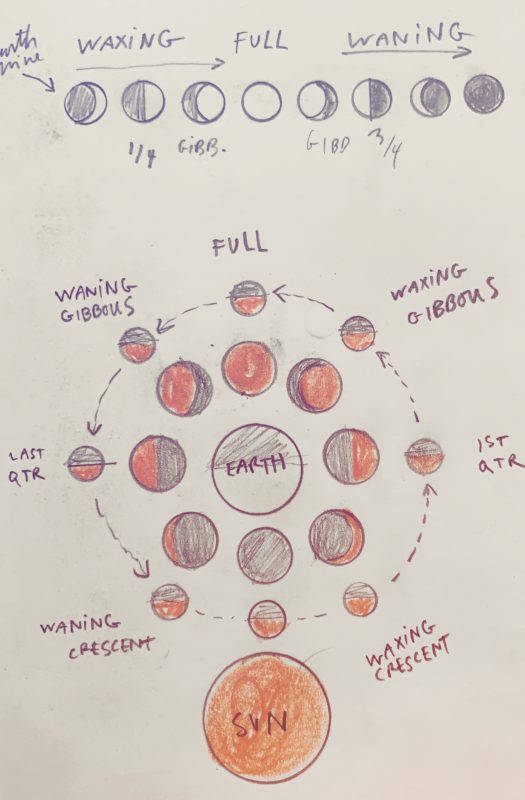
Why bother copying a diagram of the moon? Because copying is how we learn, of course, and in the course of learning how to learn again, I’ve discovered that if you want to understand something, you need to draw it out, with your own pencil and paper, to force yourself to really look at what you’re copying and internalize it.
Even better if you can start sneaking what you’re learning into your work:

Filed under: the moon
You are fine without advice and suggestions

I’ve been posting collages with a new technique and Instagram commenters keep asking me how I do them.
A few have been puzzled or even perturbed by my recent “Don’t Ask,” “Don’t Tell,” “No teaching” policy.
“Aren’t you all about sharing?”
Well, yes, I am all about sharing, which is why I posted the work in the first place.
But no, I don’t want to instruct step-by-step how the collages are done, because:
1) I’m still exploring the technique myself and I don’t want to codify it or make any rules or make it boring
2) I am certain that if curious commenters sat down and tried to approximate my technique with their own tools and materials, they would come up with something of their own.
What I really want is to rewrite this wonderful sign in an adventure playground on Governor’s Island called “The Yard.” It reads, “Your children are fine without advice and suggestions.”
I might rewrite it for adults:
YOU ARE FINE WITHOUT ADVICE AND SUGGESTIONS.
START PLAYING.