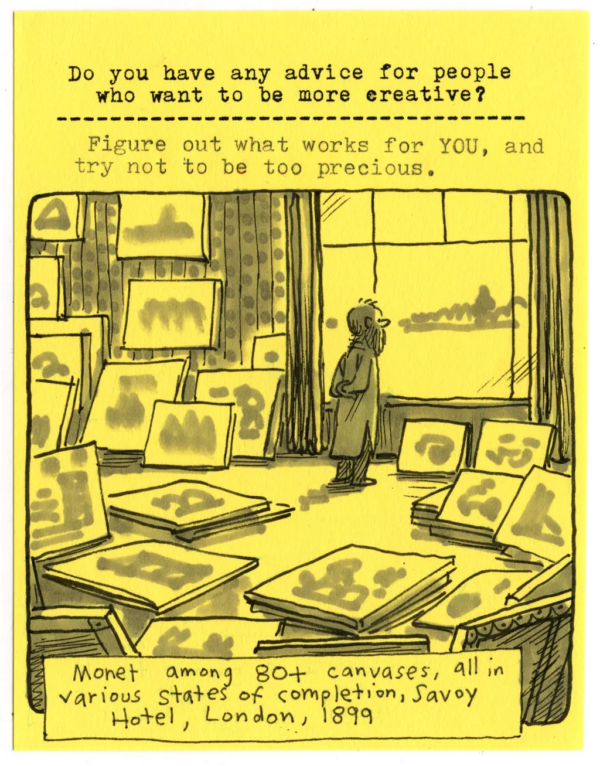
My latest typewriter interviews are with two cartoonists — one is a fully-drawn and pithy eye feast from Adam Koford, and the other a surprisingly wordy meal from Kevin Huizenga:
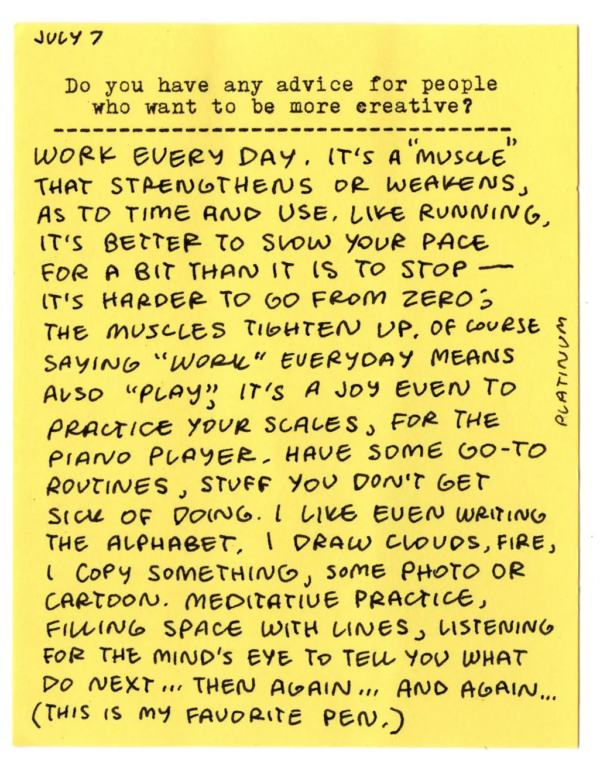
My latest typewriter interviews are with two cartoonists — one is a fully-drawn and pithy eye feast from Adam Koford, and the other a surprisingly wordy meal from Kevin Huizenga:
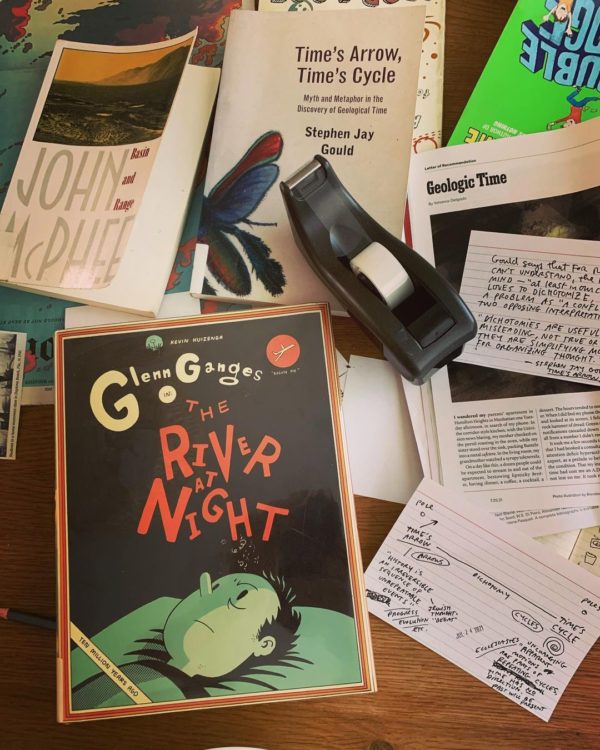
From the Dept. of No Coincidences: I was flipping through John McPhee’s Basin and Range and Stephen Jay Gould’s Time’s Arrow, Time’s Cycle: Myth and Metaphor in the Discovery of Geological Time, two books which inspired passages in Kevin Huizenga’s The River at Night, when I opened up the Sunday NYTimes magazine and found Yohanca Delgado’s letter of recommendation for thinking about geologic time.
Delgado has A.D.H.D. and a kind of “time blindness” that makes it hard for her to keep track of the passing of time. She praises Marcia Bjornerud’s Timefulness: How Thinking Like a Geologist Can Help Save the World:
[O]ur solar system has a 10-billion-year life span; it will end when the sun enters its red-giant phase and begins engulfing its orbiting planets, including Earth. In that context, Bjornerud writes, mountains are “ephemeral.” Much of what we once believed to be eternal and unchanging about our planet is vital and dynamic, constantly shifting around us. We are still deciphering parts of the planet’s geologic history, in hopes of anticipating future, potentially cataclysmic, events.
“For me,” Delgado writes, “holding time in a much larger perspective eases the day-to-day anxieties of living.”
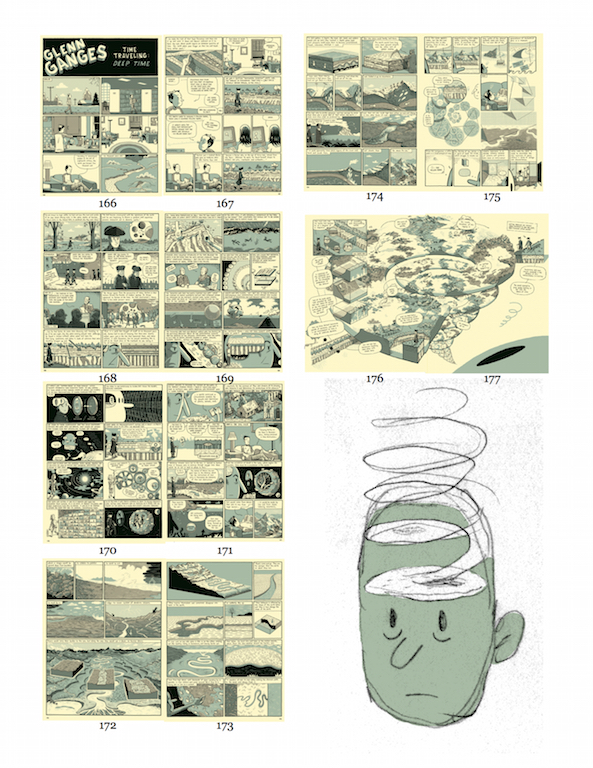
In The River at Night, the main character, Glenn Ganges, has trouble sleeping and spends most of the book thinking about the nature of time. Comics is a medium well-suited to exploring time, as explained in this interview with Art Spiegelman:
in a comic you have various panels. Those panels are each units of time. You see them simultaneously. So you have various moments in time simultaneously made present in space. And that is what Maus is about. It is about the past and present intertwining irrevocably and permanently.
A great example is R. Crumb’s “A Short History of America.”

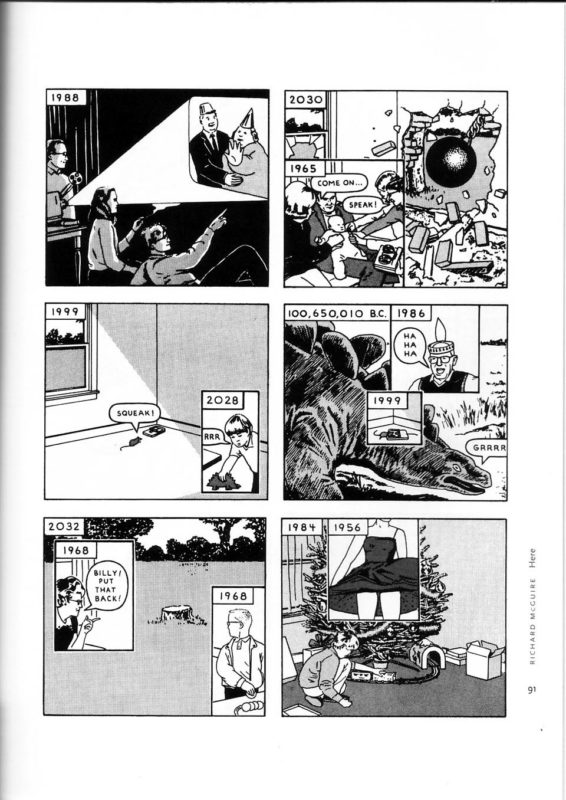
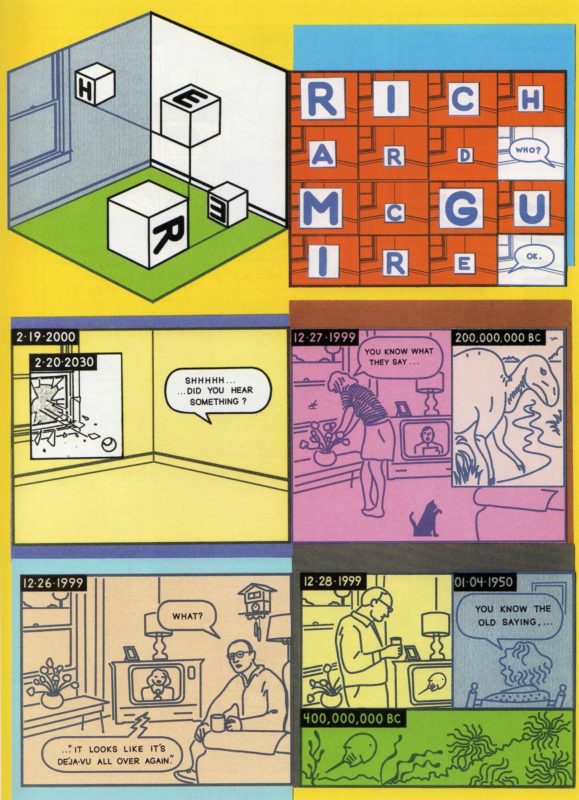
Maybe one of the most impressive examples is Richard McGuire’s Here.
In 1989, Mr. McGuire, then an aspiring New York artist better known for playing bass in the postpunk band Liquid Liquid, published a 36-panel comic that hopped backward and forward through millions of years without leaving the confines of a suburban living room, thanks to the use of pop-up frames-within-frames inspired by the relatively new Microsoft Windows… now he has popped up through a wormhole of his own, with a full-color, book-length version of “Here” that once again transforms a corner of his childhood living room in New Jersey into a staging ground for all of earthly history.
Each two-page spread features a fixed view of the room in a certain year, with pop-up windows giving glimpses of what might have been visible in exactly that spot at various moments in the past and future: from the tail of a passing dinosaur to a 1960s children’s birthday party to a quiet late-21st-century fireside chat.
The irony of comics being such a great medium for depicting and thinking about time is that comics take forever to make.
“The holy grail is to spend less time making the picture than it takes people to look at it,” Banksy supposedly once said. For cartoonists, the ratio of time spent drawing to time spent reading is enormously skewed towards the labor of drawing.
I’ve gotten away from myself, here, and lost track of time, as one often does when thinking about time.
Picturing “deep time” can keep things in perspective, just as picturing “deep space” can keep things in perspective.

But the opposite, of course, is always possible. Thinking of one’s insignificance can spend you spiraling, as it did Sally Draper, a character on Mad Men:
When I think about forever I get upset. Like the Land O’Lakes butter has that Indian girl, sitting holding a box, and it has a picture of her on it, holding a box, with a picture of her holding a box. Have you ever noticed that?
(She’s describing the Droste Effect.)
I don’t know if I’ve made this clear in other posts, but Meg and I are absolutely, positively, without-a-doubt moving to Austin, Texas around the beginning of August. Meg will be attending the University of Texas to get her Master of Science in Sustainable Design, and I will be working full-time (yikes!) somewhere to support us.
What we are excited about:
What we are NOT excited about:
As our move approaches, I’ve been thinking more an more about quality of life — how easy we have it here in Cleveland, and how we might make it even better in Texas. For us, anxiety is usually only the product of Unknown Factors, and our Unknown Factors are big ones: Where To Live and Where to Work.
There was a New Yorker article on commuting a week or so ago (it coincidentally had a cool illustration of Glenn Ganges in traffic by Kevin Huizenga) that had a very practical way of looking at the Where To Live, Where To Work question:
Putnam likes to imagine that there is a triangle, its points comprising where you sleep, where you work, and where you shop. In a canonical English village, or in a university town, the sides of that triangle are very short: a five-minute walk from one point to the next. In many American cities, you can spend an hour or two travelling each side. “You live in Pasadena, work in North Hollywood, shop in the Valley,” Putnam said. “Where is your community?” The smaller the triangle, the happier the human, as long as there is social interaction to be had. In that kind of life, you have a small refrigerator, because you can get to the store quickly and often. By this logic, the bigger the refrigerator, the lonelier the soul.
Our triangle here in Cleveland is pretty small: we can’t walk to work, but we can and do walk to the grocery store, to the Chipotle, to the book store. I’m hoping we can find a similar situation in Austin.
As for the job search, I have this Bruce Eric Kaplan cartoon posted to the fridge:

If you are an employer — or if you know of an employer — in Austin who is looking for a writer/designer with plenty o’ computer, web design, and customer service experience…please contact me!
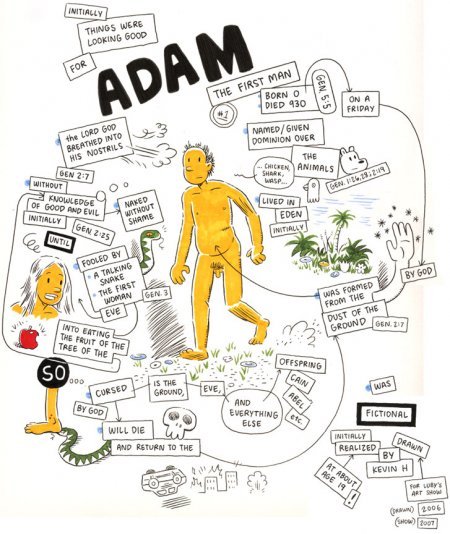
There was this job I had where I was working at a place called XPLANE, which was an illustration company that did these visual explanation things, and a lot of times that amounted to these diagrammatic/comics illustrations. That really got me interested in diagrams. And after thinking for a while about diagrams, the stories that I did while I worked there have a lot of diagrams in them, and that carried on through. I started collecting old science textbooks and so forth that had these nice illustrated diagrams. It made me realize that since I was in high school and Understanding Comics came out, I’ve always thought about the comics form. And something I started realizing recently is that we talk about comics being a mixture of image and text, but it really seems to me that a part of the way comics works is in this sort of diagrammatic space. You have a pictorial space, which follows certain pictorial norms, and then you have the text part of comics, which follows the syntactical structure of text and language. What comics does is it has this particular way of diagramming those things together using the panel unit and the word balloon as symbols for certain things. I really realized that that was the part of comics that appealed to me the most. When I look at other cartoonists, I think that they’re real pictorial cartoonists. They’re really interested in the image part of comics. And there are other cartoonists who are really interested in stories and the subjects we associate with literary storytelling like character, plot and so on. I realized the thing that interested me in comics is the way all of that stuff is diagrammed on the page and the way that you read it.”
– Kevin Huizenga, interview
Links:

“You look just like…”
I’ve heard Robert Downey Jr. and Donnie Darko, but now it’s “that guy who got shot last night on CSI.”
What do you say to this stuff?
I get this brand of couch potato free-associating day in and day out at the reference desk. And it’s always from someone in sweatpants. Never someone you’d actually want a compliment from.
“Thank you, I’m glad I remind you of a celebrity, even a minor one. My sense of self-worth has sky-rocketed.”
Okay, enough griping.
They have nothing to do with this post, but I like pretty much everything that Tom Gauld, Anders Nilsen, John Porcellino, and Kevin Huizenga put out.
This site participates in the Amazon Affiliates program, the proceeds of which keep it free for anyone to read.