
Thought of this one after witnessing a grown man have a tantrum in public. There but for the grace…
Thought of this one after witnessing a grown man have a tantrum in public. There but for the grace…
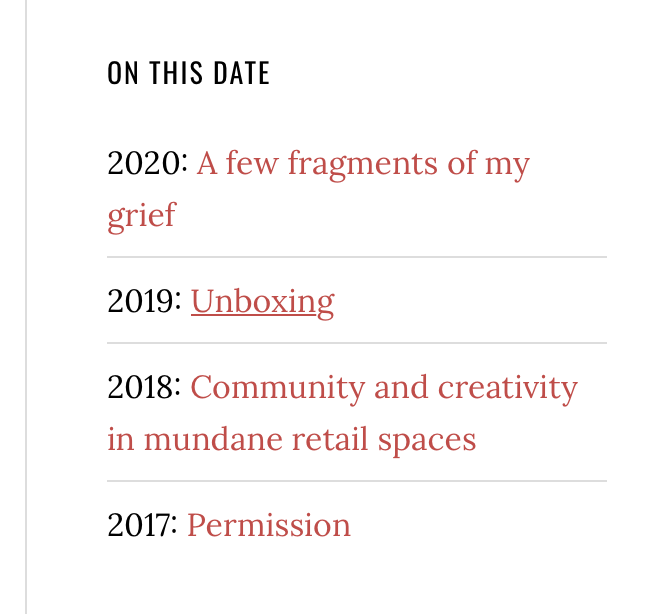
One of my new studio routines is to re-read my diaries on today’s date. (Something I learned from reading Thoreau’s diary.)
So, today, for example, when I got in the studio, I went to March 27th of each year 2017-2022 and read what was there. There are almost always weird connections and things worth writing about.
I thought it would be fun to be able to this with my blog, too, which is much older than my diaries, so I used ChatGPT to help me write a WordPress widget that shows me “On This Date” posts from the past few years on my sidebar.
3 posts it turned up that spoke to each other:
2019: Unboxing my copies of Keep Going for the first time.
2017: My notes on a show by Nina Katchadourian, who was a big influence on Keep Going.
2008: “Overheard on the Titanic,” a post that ended up being my most famous blackout poem and opens Keep Going.
“Overheard on the Titanic”
I made this poem on this day 15 years ago pic.twitter.com/LkfHMOhCIs
— Austin Kleon (@austinkleon) March 27, 2023
It will be fun to check the blog every day for the next year and see what comes up.
Exercises like this reinforce my belief in the cyclical nature of time.
* * *
Update (3/28/2023): Today serves me the original “How To Keep Going Talk” from 2018 and “Potential Reactions” from 2015 that made it into the book. And from 2019, “The Page is A Place,” which is spookily similar to a post I wrote this morning, “A journal is a place to hang out.”
In the comments of my “spring bouquet” newsletter, Ann Collins, writer of the newsletter Microseasons, wrote:
At certain times of the year, I feel like time is both— linear and circular! And that is what has sparked my fascination with the ancient idea of 72 microseasons —each lasting just 5 days. Five days seems like a linear, human-sized, tangible amount of time. Yet the small linear segments are part of a larger Circle of an entire year, which is, in turn, part of a larger Spiral made of many years.
I really like this. (I follow @smallseasonsbot on twitter to remind me of these seasons.)
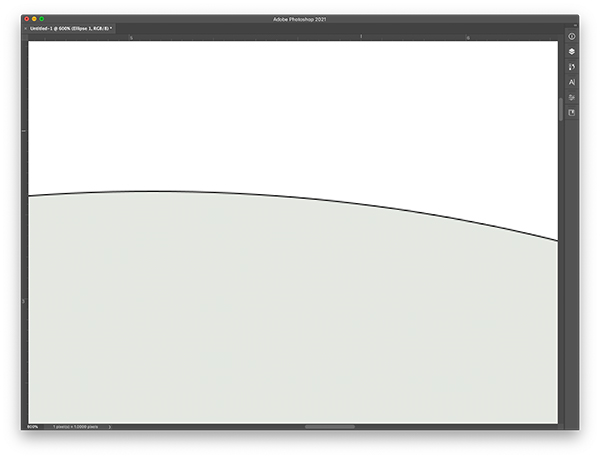
On this image of circular vs. linear time: It made me think about how if you draw a circle in Photoshop and keep zooming in, eventually the circle will look something like a straight line or (depending on the resolution) a series of steps:

Ann also sent me Tomas Tranströmer’s poem, “Answers to Letters”:
Sometimes an abyss opens between Tuesday and Wednesday but twenty-six years may be passed in a moment. Time is not a straight line, it’s more of a labyrinth, and if you press close to the wall at the right place you can hear the hurrying steps and the voices, you can hear yourself walking past there on the other side.
I could probably talk about moving in a straight line in curved spacetime, but I wouldn’t really know what I was talking about. (Think of the way the earth seems pretty darned flat when you’re driving across Texas.)
Ann’s great point remains: In the micro sense, time usually feels linear — like a line of weekdays on a calendar. But in the macro sense, say, revisiting your notebooks over many years, it often feels circular.
“Oh, Time, Strength, Cash, and Patience!”
—Herman Melville
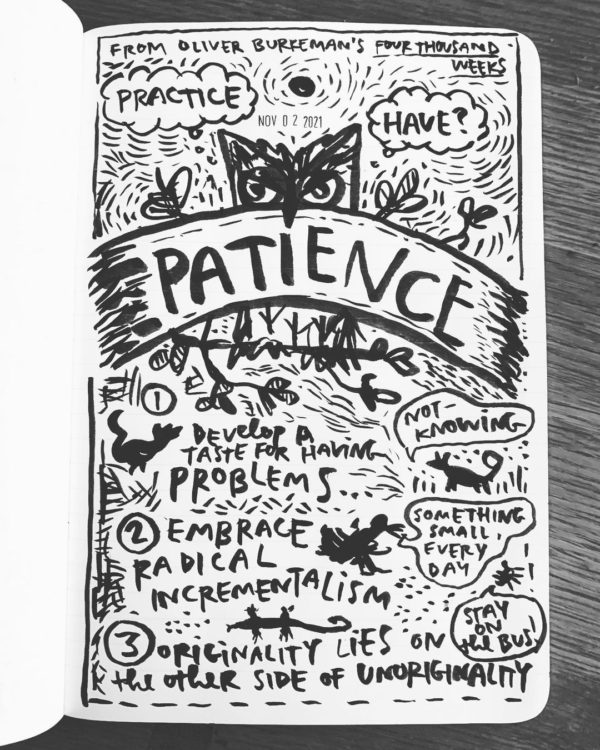
In Oliver Burkeman’s excellent latest book, Four Thousand Weeks: Time Management for Mortals, he outlines 3 principles for “harnessing the power of patience as a creative force in daily life.”
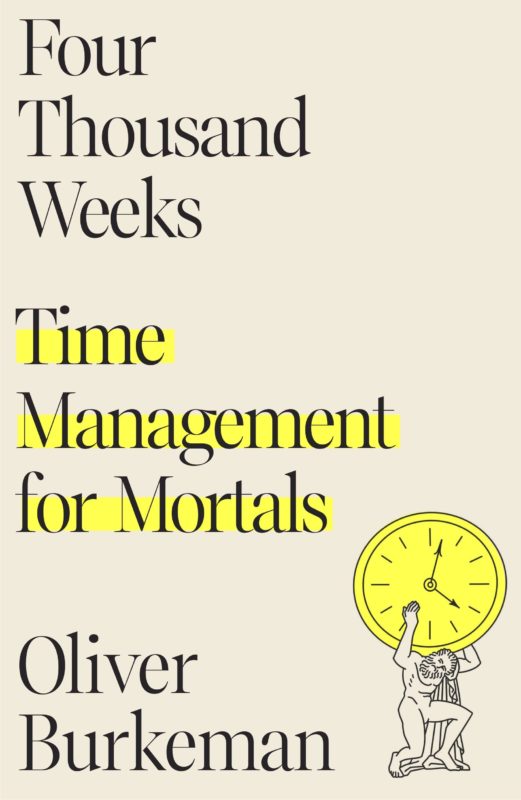 1. “Develop a taste for having problems.”
Burkeman quotes the French poet Christian Bobin:
I was peeling a red apple from the garden when I suddenly understood that life would only ever give me a series of wonderfully insoluble problems. With that thought, an ocean of profound peace entered my heart.
The sooner you welcome uncertainty and not-knowing as normal ways of being, the better off you’ll be.
2. “Embrace radical incrementalism.”
People who work a little bit every day tend to cultivate the patience it takes to get good. These people also quit their day’s work when it’s finished: they identify what their chunk of time or task is per day, they do that and only that, and save more for tomorrow. (See: “Something small, every day” and the “Chain-smoking” chapter of Show Your Work!)
3. “More often than not, originality lies on the far side of unoriginality.”
To illustrate this point, Burkeman uses The Helsinki Bus Station Theory. (The original speech is here.) As the photographer Arno Minkkinen explained, Helsinki bus lines start out traveling the same path but then diverge at different points in the route, spreading out to far and wide locales. When you find your work resembles someone else’s, or you’re on someone else’s bus, traveling someone else’s path, don’t try to go back to the bus station at the very beginning and completely reinvent yourself and start from scratch, keep working and “stay on the bus!” At a certain point, your path will split off into something new. (I wrote a book about this called Steal Like An Artist.)
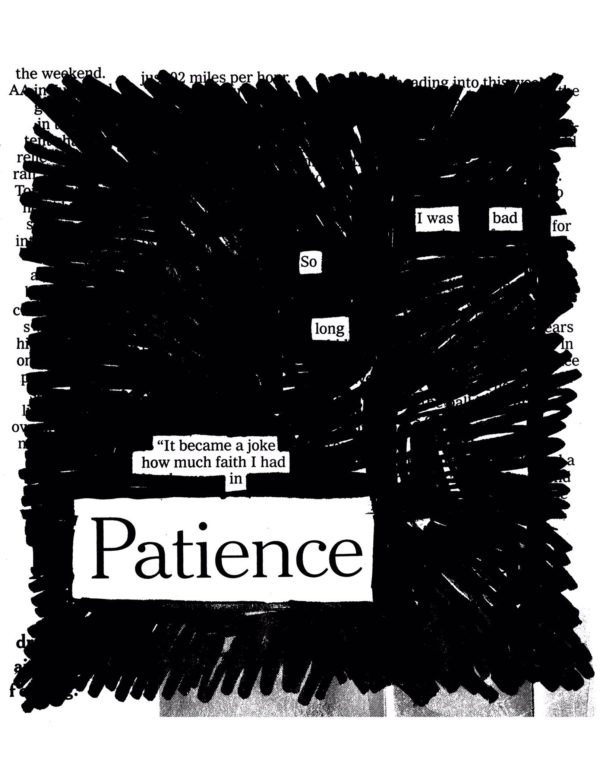
In going through my “patience” files, I found this lovely thought from a piece about helping students develop “the power of patience”:
The art historian David Joselit has described paintings as deep reservoirs of temporal experience—“time batteries”—“exorbitant stockpiles” of experience and information.
This is one of my favorite ideas: that art contains embodied energy that we can unlock, activate, and tap into with our attention. Our energies unlock the stored energy.
We must assume the same is true of our own work: that we must take the time to stockpile enough our own energy in the work so it may be worthy of the energies of others. But the energy in the work won’t just consist of the time we spent actually making it, it will also consist of all the time we spent leading up to the work… all the days we thought were going nowhere…
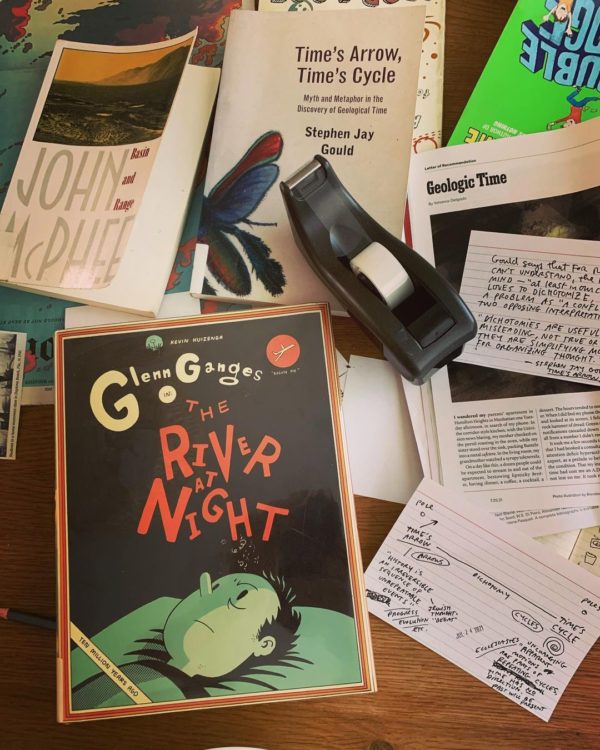
From the Dept. of No Coincidences: I was flipping through John McPhee’s Basin and Range and Stephen Jay Gould’s Time’s Arrow, Time’s Cycle: Myth and Metaphor in the Discovery of Geological Time, two books which inspired passages in Kevin Huizenga’s The River at Night, when I opened up the Sunday NYTimes magazine and found Yohanca Delgado’s letter of recommendation for thinking about geologic time.
Delgado has A.D.H.D. and a kind of “time blindness” that makes it hard for her to keep track of the passing of time. She praises Marcia Bjornerud’s Timefulness: How Thinking Like a Geologist Can Help Save the World:
[O]ur solar system has a 10-billion-year life span; it will end when the sun enters its red-giant phase and begins engulfing its orbiting planets, including Earth. In that context, Bjornerud writes, mountains are “ephemeral.” Much of what we once believed to be eternal and unchanging about our planet is vital and dynamic, constantly shifting around us. We are still deciphering parts of the planet’s geologic history, in hopes of anticipating future, potentially cataclysmic, events.
“For me,” Delgado writes, “holding time in a much larger perspective eases the day-to-day anxieties of living.”
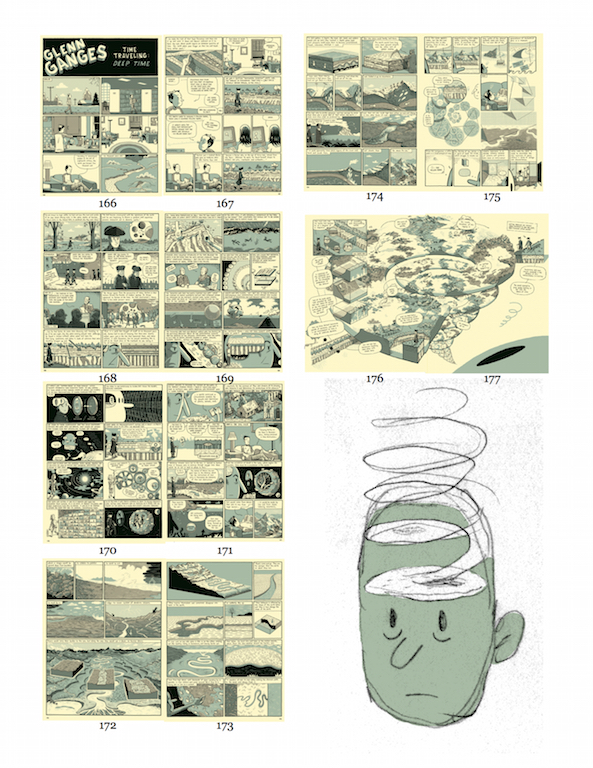
In The River at Night, the main character, Glenn Ganges, has trouble sleeping and spends most of the book thinking about the nature of time. Comics is a medium well-suited to exploring time, as explained in this interview with Art Spiegelman:
in a comic you have various panels. Those panels are each units of time. You see them simultaneously. So you have various moments in time simultaneously made present in space. And that is what Maus is about. It is about the past and present intertwining irrevocably and permanently.
A great example is R. Crumb’s “A Short History of America.”

Maybe one of the most impressive examples is Richard McGuire’s Here.
In 1989, Mr. McGuire, then an aspiring New York artist better known for playing bass in the postpunk band Liquid Liquid, published a 36-panel comic that hopped backward and forward through millions of years without leaving the confines of a suburban living room, thanks to the use of pop-up frames-within-frames inspired by the relatively new Microsoft Windows… now he has popped up through a wormhole of his own, with a full-color, book-length version of “Here” that once again transforms a corner of his childhood living room in New Jersey into a staging ground for all of earthly history.
Each two-page spread features a fixed view of the room in a certain year, with pop-up windows giving glimpses of what might have been visible in exactly that spot at various moments in the past and future: from the tail of a passing dinosaur to a 1960s children’s birthday party to a quiet late-21st-century fireside chat.
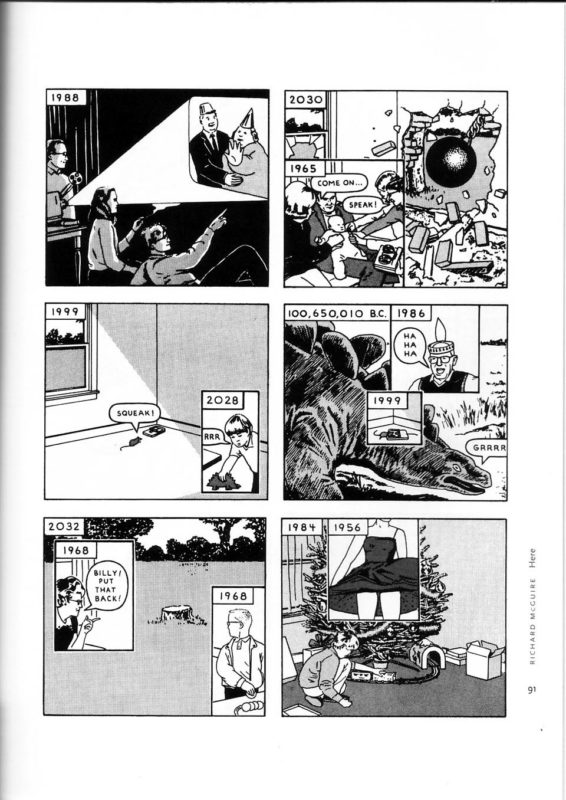
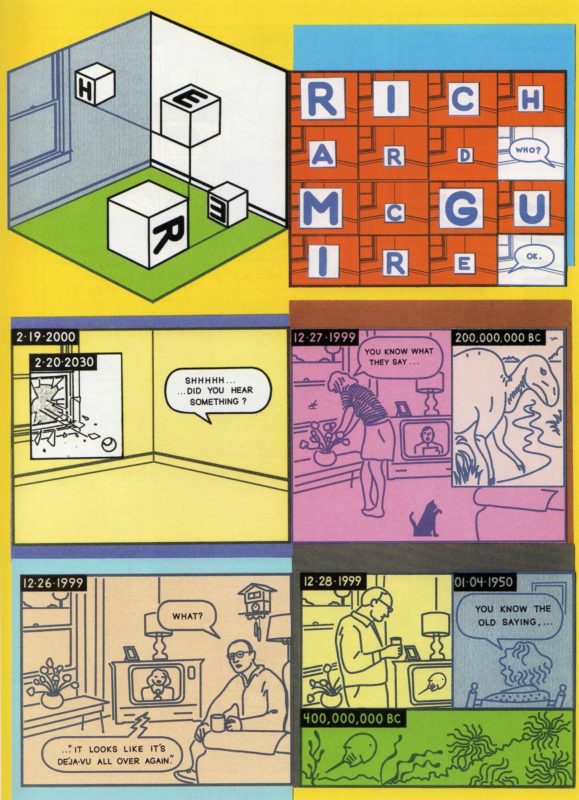
The irony of comics being such a great medium for depicting and thinking about time is that comics take forever to make.
“The holy grail is to spend less time making the picture than it takes people to look at it,” Banksy supposedly once said. For cartoonists, the ratio of time spent drawing to time spent reading is enormously skewed towards the labor of drawing.
I’ve gotten away from myself, here, and lost track of time, as one often does when thinking about time.
Picturing “deep time” can keep things in perspective, just as picturing “deep space” can keep things in perspective.
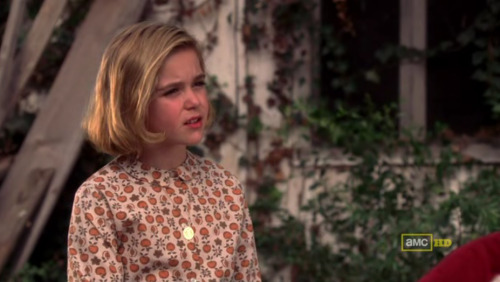
But the opposite, of course, is always possible. Thinking of one’s insignificance can spend you spiraling, as it did Sally Draper, a character on Mad Men:
When I think about forever I get upset. Like the Land O’Lakes butter has that Indian girl, sitting holding a box, and it has a picture of her on it, holding a box, with a picture of her holding a box. Have you ever noticed that?
(She’s describing the Droste Effect.)
This site participates in the Amazon Affiliates program, the proceeds of which keep it free for anyone to read.