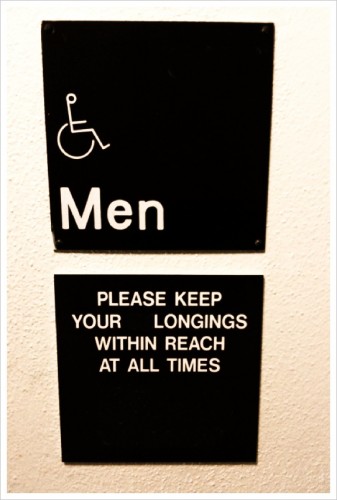
A little experiment. Photo taken with my Iphone, altered with the iRetouch app, filtered with CameraBag.
A little experiment. Photo taken with my Iphone, altered with the iRetouch app, filtered with CameraBag.
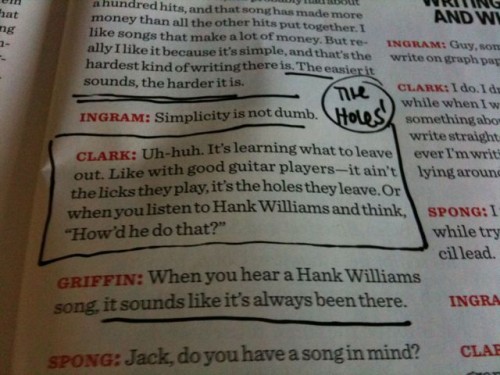
The above snippet came from a Texas Monthly article on Texas songwriters I read on the plane this morning.
It reminded me of Ronald Johnson, in his introduction to radi os, a long poem made by erasing words from Milton’s Paradise Lost: “I composed the holes.” (Johnson was quoting a composer whose name I forget at the moment.)
Composing the holes. That’s what we do when we craft a piece of art, whether it’s drawing or making a blackout poem.
It’s often the holes in pieces of art that make them interesting. What isn’t shown vs. what is.
The same could be said of people. What makes them interesting isn’t just what they’ve experienced, but what they haven’t experienced.
Devoting yourself to something means shutting out other things.
When it comes to education, it’s not just the holes, but the order you fill them in. For instance, if you read the canon straight through, from Homer to McCarthy (or whoever), how original would the connections in your mind be? Better to start with one author you love, who speaks to you, and move in every direction, backwards, forwards, sideways…the juxtapositions you see and the connections you make in your brain will be more unique.
The same is true when you make art: you must embrace your limitations and keep moving.
Compose your holes.
(Written on my iPhone in the Houston airport.)
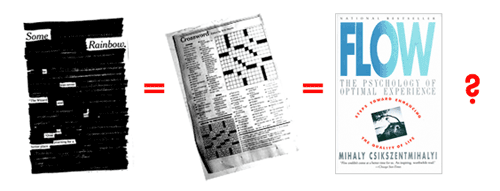
While re-reading Mihaly Csikszentmihalyi’s wonderful book Flow: The Psychology of Optimal Experience, I came across this passage on working crossword puzzles. I think he could just as well be talking about making blackout poems:
There is much to be said in favor of this popular pastime, which in its best form resembles the ancient riddle contests. It is inexpensive and portable, its challenges can be finely graduated so that both novices and experts can enjoy it, and its solution produces a sense of pleasing order that gives one a satisfying feeling of accomplishment. It provides opportunities to experience a mild state of flow to many people who are stranded in airport lounges, who travel on commuter trains, or who are simply whiling away Sunday mornings.
Csikszentmihalyi then goes on to talk explicitly about poetry and writing:
What’s important is to find at least a line, or a verse, that starts to sing. Sometimes even one word is enough to open a window on a new view of the world, to start the mind on an inner journey….
And the joys of being an amateur (why leave it to professionals?):
Not so long ago, it was acceptable to be an amateur poet….Nowadays if one does not make some money (however pitifully little) out of writing, it’s considered to be a waste of time. It is taken as downright shameful for a man past twenty to indulge in versification unless he receives a check to show for it.
UPDATE (6/30/08): Weird timing: a reader from Tacoma, Washington messaged me and said her local newspaper, The News Tribune, is running a blackout poems contest. (I’ve archived the full text in the comments.)

It seems to me that the language of poetry is very dependant on setting up images and juxtaposing them against each other. A poet will create an image in the first two lines of his poem and then he will create another in the next two lines, and so on. I do find this jumping from image to image in poetry to be a very interesting, comic-like element. Many poems are almost like word comics.—The cartoonist Seth on poetry and comics
I don’t know if I’ve mentioned this recently, but in the beginning, I called my poems “Newspaper Blackout Comics.” The first batch I ever did explicitly juxtaposed image and text:
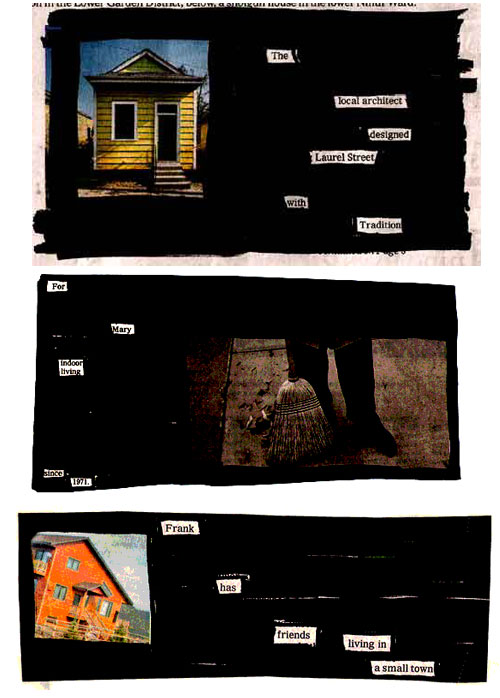
Other examples: here and here.
My old creative writing teacher used to tell me that a poet “thinks in images” and a fiction writer thinks in terms of “character and plot.” I’m not sure it’s that cut and dry, but I think it sheds a lot of light on why I find traditional prose fiction so incredibly hard, and poetry and comics so incredibly fun.
And speaking of poetry and comics, one of the main characters in Chris Harding’s excellent WE THE ROBOTS webcomic has started a poetry website:
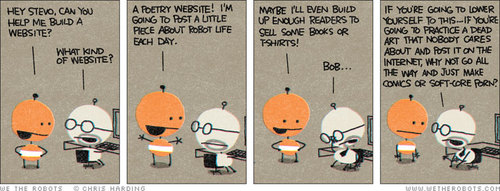
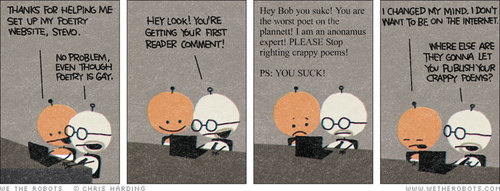
So hilarious, and so true. Be sure to visit his site for even more.
And speaking of mean comments, here’s a new phenomenon for me: mean-spirited spam.
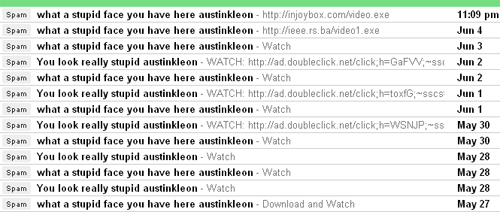
As if it wasn’t hard enough for me to get up in the morning!
Leland Myrick’s MISSOURI BOY started out as a batch of poems that he put together and made into a graphic novel. He has a wonderful post about the process over at the First-Second blog:
…the poems that eventually became MISSOURI BOY were written over a span of almost ten years and were quite different in form, ranging from blank verse to haiku. When the idea finally gelled that I would take all these disparate poems and meld them into one coherent graphic novel, I began to think about the process of turning poetry into comics, and in thinking about the process, I began to feel my way toward the kind of book I wanted MISSOURI BOY to be when it was finished. What I did NOT want was a book of illustrated poems. What I wanted was a graphic novel that moved through time and in the end told one large story through a bunch of little moments strung together, the little moments fairly clear in themselves, but the larger story more indistinct as seen through the scattered lenses of the individual chapters.
One of the most important things that happened in the transformation from poem to comic was the loss of words. My editor, Mark Siegel used what became an important phrase for me in the early stages of the book when I was still struggling with keeping the language of the original poems intact—Let the words fall away. And so I did. In my head I saw the words falling away, floating leaves settling on the floor around my drawing table.
This site participates in the Amazon Affiliates program, the proceeds of which keep it free for anyone to read.