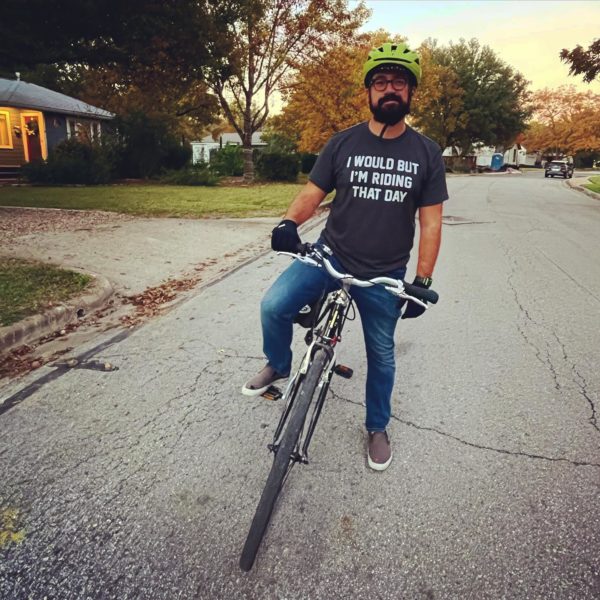
One of my riding partners is hard of hearing, so sometimes I’ll say I was “writing” and he thinks I’ve said, “riding.” (Or vice versa.) I’m thinking of getting another version of this shirt made that says, “I would but I’m writing that day.” But the truth is, a lot of my writing comes from my riding these days… (Photo by my pal Marty from yesterday evening’s impromptu ride.)
A solution to writer’s block: Transcribe yourself
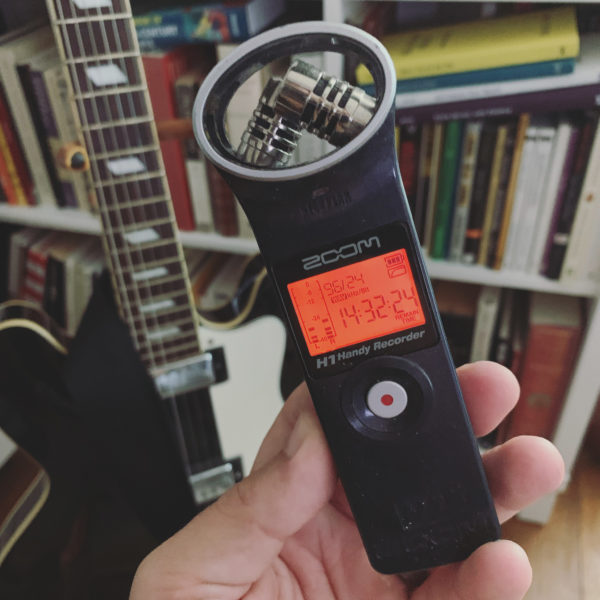
Stewart Brand once said to Brian Eno: “Why don’t you assume you’ve written your book already — and all you have to do now is find it?”
In a similar vein, I enjoyed this story of how KC Davis, author of the brilliantly-titled How To Keep House While Drowning, wrote their book:
I had long stared at blank word documents, unable to get my thoughts on the page. I’m actually not a great writer — but I am a pretty good speaker. So I went back through my social channels and transcribed every short form video I had ever done on this topic and that left me with all these disjointed paragraphs. I spent another two months trying to decide how to connect these little vignettes into a “real” book and finally realized that my choices were to publish an imperfect book or not publish the perfect book. So I decided to make each section its own chapter — some only a page long.
I’m reminded of this advice from Matt Zoller Seitz:
Here is a technique I suggest to fellow writers who are blocked for whatever reason: just talk about the piece with a friend, record it, then play it back and write down the good stuff. This method also works with Gchat & similar programs. Go straight to document after.
And how Nicholson Baker wrote his brilliant book The Anthologist by filming himself with a camcorder:
He set up a camcorder and recorded himself presenting in various parts of his house. “I would try to rehearse what it would be like to explain something complicated, like iambic pentameter, in a familiar way,” says Baker, who also found himself singing poetry in his own barn, in Maine. “How would you explain it if you’d been thinking about it for twenty years? So I came up with 40 hours of tape and transcribed the audio.”
I suppose one could skip the transcription step by talking directly into the computer’s speech-to-text?
I know a lot of songwriters do this with song ideas: they record a bunch of voice memos on their phone, but then they make time to listen to what they’ve recorded, often on shuffle.
Regardless of the tech you use, the method is: record yourself thinking out loud, and once you’ve transcribed that into a draft: edit yourself by reading out loud.
Homework every night for the rest of your life
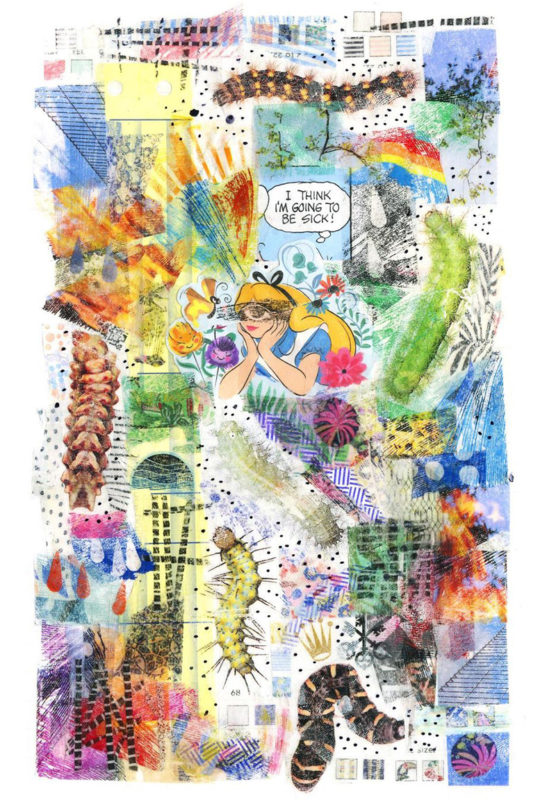
Filmmaker Lawrence Kasdan once said, “Being a writer is like having homework every night for the rest of your life.”
That’s the thing about the job: you’re never “off.” If “everything is copy” (Nora Ephron) then you’re always “on,” even when it looks like you’re doing nothing. (Arm yourself with Gertrude Stein, if only as a joke: “It takes a lot of time to be a genius. You have to sit around so much, doing nothing, really doing nothing.”)
“All things are potential paragraphs for the writer,” wrote Shirley Jackson in her lecture, “Memory and Delusion” (collected in Let Me Tell You):
I cannot find any patience for those people who believe that you start writing when you sit down at your desk and pick up your pen and finish writing when you put down your pen again; a writer is always writing, seeing everything through a thin mist of words, fitting swift little descriptions to everything he sees, always noticing. Just as I believe that a painter cannot sit down to his morning coffee without noticing what color it is, so a writer cannot see an odd little gesture without putting a verbal description to it, and ought never to let a moment go by undescribed.
The “always on” thing can feel like a curse, but it’s also a blessing: it means that any boring old experience (grocery shopping, getting stamps at the post office, picking your kids up from school) can become potential fodder for the work, so you’re “always on,” always paying attention, alert, awake to life, alive, casing the joint, looking for stuff to steal.
Sometimes I collage my kids’ homework in my diary pic.twitter.com/4PdS14Smgb
— Austin Kleon (@austinkleon) December 19, 2021
To find a form that accommodates the mess
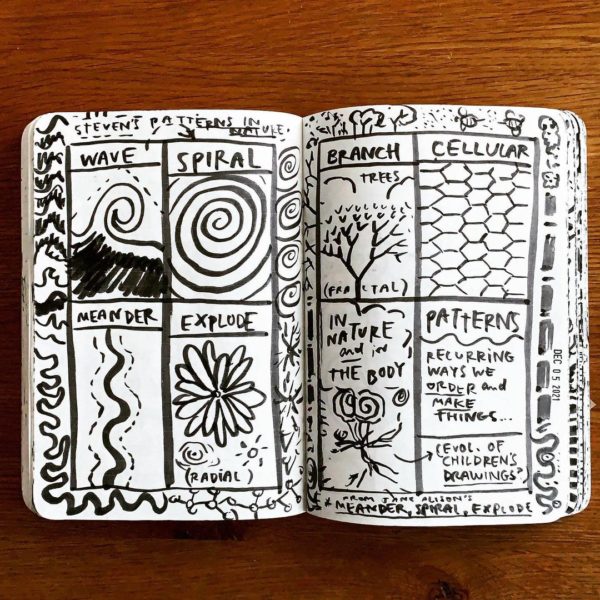
In a 1961 interview, Samuel Beckett pointed out “the mess” of modern life, “this buzzing confusion.”
“The confusion is not my invention. We cannot listen to a conversation for five minutes without being acutely aware of the confusion. It is all around us and our only chance now is to let it in. The only chance of renovation is to open our eyes and see the mess. It is not a mess you can make sense of.”
The Poetry Foundation helps explain:
[Critic David] Hesla notes that the dilemma which confronts the contemporary writer, according to Beckett, “is constituted… by the fact that the writer must take seriously two opposed and apparently irreconcilable claims to his allegiance. On the one hand, he must recognize that the principal fact about modern man’s life is that it is a ‘mess,’ a ‘confusion,’ a ‘chaos.’ On the other hand, the writer, as artist, has an obligation to form. But to admit the ‘mess’ into art is to jeopardize the very nature of art; for the mess ‘appears to be the very opposite of form and therefore destructive of the very thing that art holds itself to be.’”
Beckett said we could no longer keep out the mess, because “it invades our experience at every moment. It is there and it must be allowed in.”
What I am saying does not mean that there will henceforth be no form in art. It only means that there will be a new form; and that this form will be of such a type that it admits the chaos and does not try to say that the chaos is really something else. The form and the chaos remain separate. The latter is not reduced to the former. That is why the form itself becomes a preoccupation, because it exists as a problem separate from the material it accommodates. To find a form that accommodates the mess, that is the task of the artist now.
Seems as good of a mission statement as any.
I am a compost heap
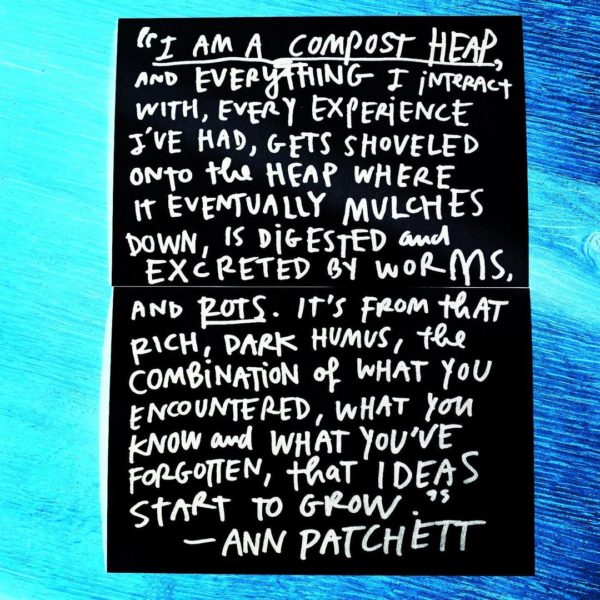
Ann Patchett’s short memoir of her writing life, “The Getaway Car,” collected in her book, This is The Story of a Happy Marriage, is one of the best things on writing I’ve read.
I particularly loved this bit, stealing like an artist meets a gardening metaphor:
You will take bits from books you’ve read and movies you’ve seen and conversations you’ve had and stories friends have told you, and half the time you won’t even realize you’re doing it. I am a compost heap, and everything I interact with, every experience I’ve had, gets shoveled onto the heap where it eventually mulches down, is digested and excreted by worms, and rots. It’s from that rich, dark humus, the combination of what you encountered, what you know and what you’ve forgotten, that ideas start to grow.
Of research, for example, she writes, “I try to shovel everything I learn onto the compost heap instead of straight into the book.”
I’ve often thought that an artist has to be like the Mr. Fusion device Doc Brown uses in Back To The Future, but I like the compost heap even better.
The cool thing about a compost heap is that you can throw whatever organic matter you want on it. (“Hold on to your anger,” Thich Nhat Hanh told bell hooks, “use it as compost for your garden.”)
If you’re just throwing stuff on the compost heap, you don’t have to worry about being pure, or perfect. (“Writing…always, always only starts out as shit,” David Rakoff said. It’s like “reverse-engineer a meal out of rotten food.”)
And, as Brian Eno told us, “Beautiful things grow out of shit.”
- ← Newer posts
- 1
- …
- 3
- 4
- 5
- 6
- 7
- …
- 26
- Older posts→