BROADSHEETS
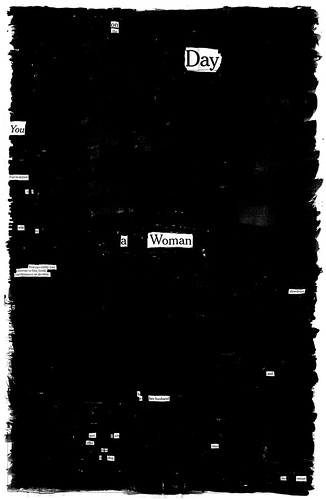
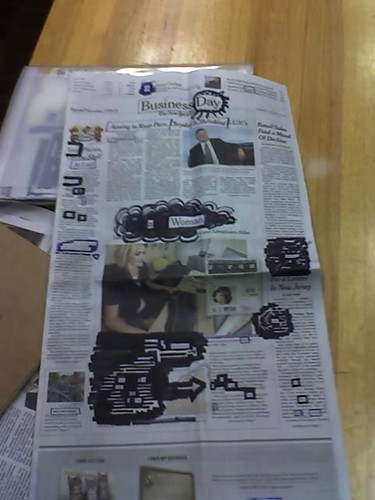
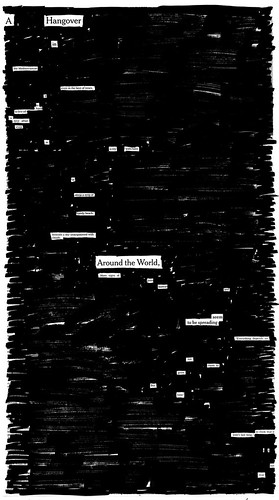
3 or 4 months ago I did a batch of full-page “broadsheet” newspaper blackout poems — using the entire page of the newsprint. I soon realized they were a lot of work, and I probably couldn’t use them for the book anyways. So I dropped them. I did, however, take the time to scan a couple and found the scans recently on my hard drive. If you click the images below you can read them. I’ve also included a few “in progress” shots.
“On The Day”

* * *
“A Hangover In The Mediterranean”
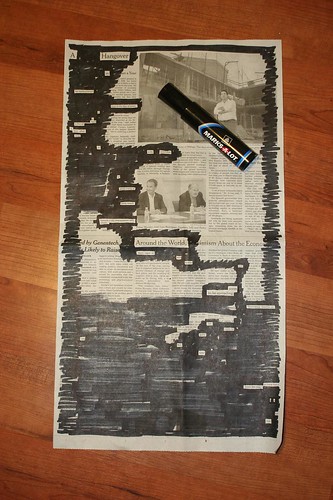
* * *
“The Curator”
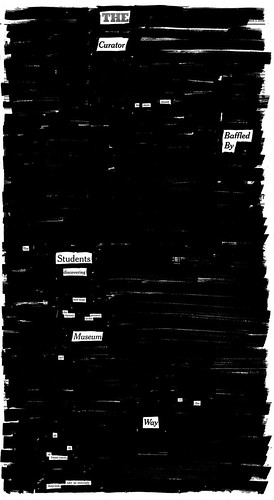
* * *
“Olympic Games”
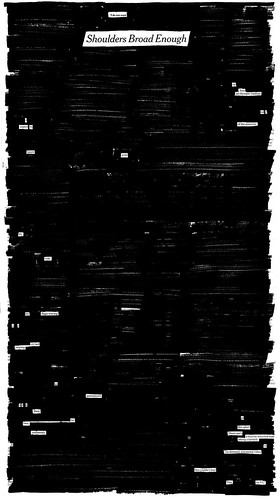
* * *
It’s funny, looking at these again, I’m reminded of how important size and dimensions are to the success of the poems.
Normal-sized, they’re really easy to read (usually) on one monitor screen. I’ve always tried to make them the size of a paperback book. (Wishful thinking?)
Broadsheet-sized, they’re really hard to get a look at online–they take a long time to load, and you have to do a lot of scrolling.
My guess is that if I’d only worked on full-paged poems, they’d never become as popular as they have. I’m not even sure they’d work well as posters — it’d just be a sea of black hanging on a wall.
No matter!
* * *
In other news, here’s some blackout fan mail that I received the other day from a girl who grew up near me (we’ve never met). It was one of the funniest e-mails I’ve ever received:
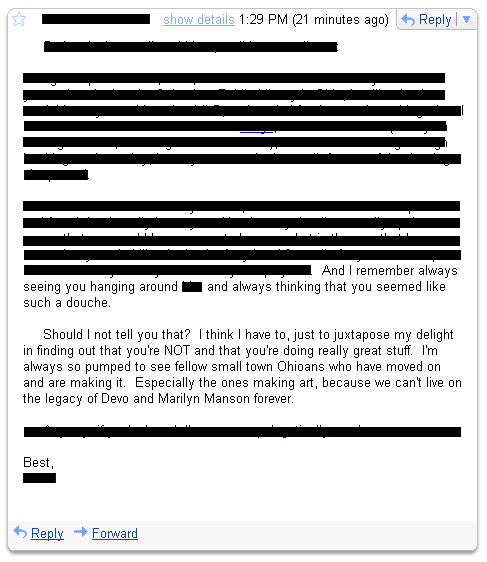
I took it as a compliment.
CAPTAIN’S LOG
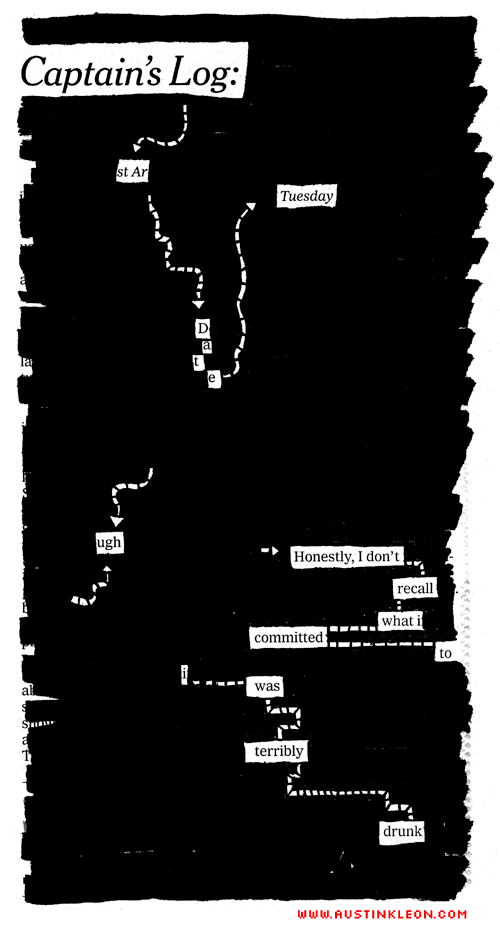
Did this one today at lunch. It’s going I think it’ll go in the book.
LAY IT ALL OUT WHERE YOU CAN LOOK AT IT
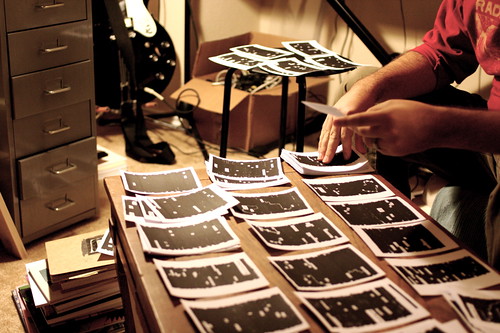
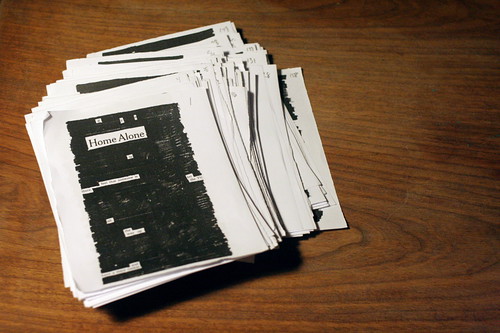
Meg took these shots of me working on the book. At this stage, I have about 175 poems scanned and cleaned up. I’d like to have about 150. I was trying to organize them all on the computer in Adobe Bridge, but I wanted to be able to see them all, to touch them, to shuffle them, stack them, sort through them. I decided to print them all out on paper. Now I’m looking for themes and threads, stories and characters, trying to make this thing flow.
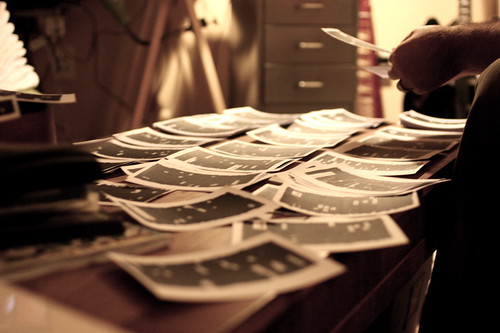
It’s a lot like making a mixtape, or sequencing an album. The way the songs butt up against each other can totally color their meanings. One could craft a hundred different albums from the same batch of songs.
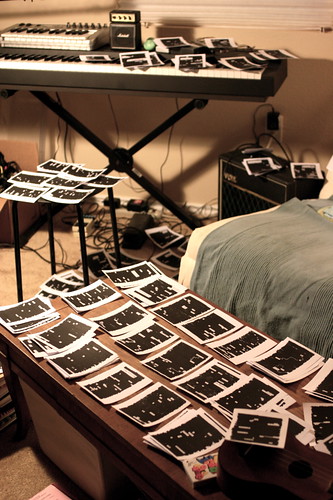
The task now is looking. Trying to see a book in this stack of pages.
Dan Roam, in his book, The Back of the Napkin, says “there are four basic rules to apply every time we look at something new.”
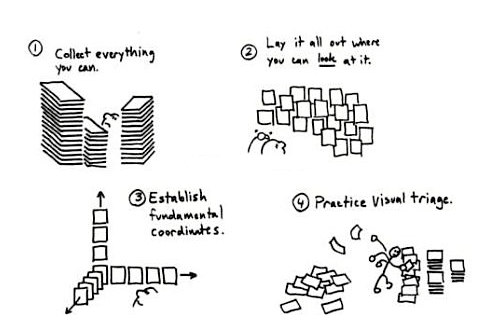
1. Collect everything we can to look at—the more the better (at least at first).
2. Have a place where we can lay out everything and really look at it, side by side.
3. Always define a basic coordinate system to give us a clear orientation and position.
4. Find ways to cut ruthlessly from everything our eyes bring in—we need to practice visual triage.
Lay it all out where you can look at it. As Edward Tufte says, “Whenever possible, show comparisons adjacent in spaces, not stacked in time.”
Looking leads to seeing which leads to meaning.
David Hockney came to his theory on optics and painting by pinning a photocopied timeline of paintings down one wall of his studio:
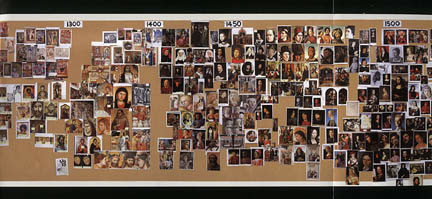
He looked and was able to see a story.
Let’s hope it works for me.
NEWSPAPER BLACKOUT POEMS IN THE CLASSROOM
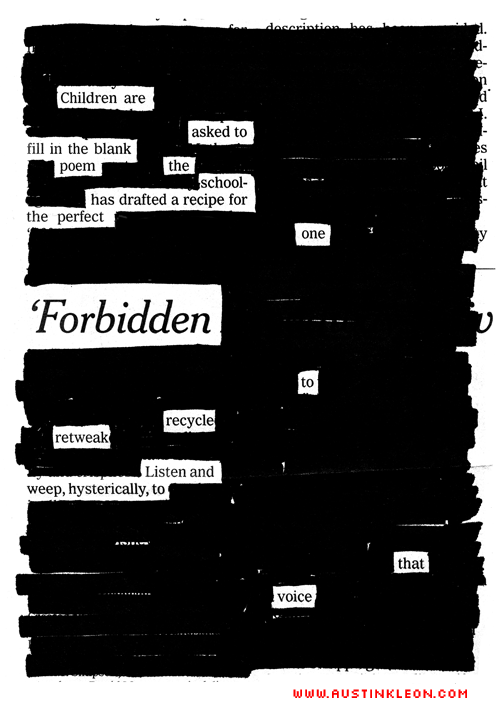
Are you or do you know of a teacher or student who has used Newspaper Blackout Poems in the classroom? Are you a writer using them in your writing group or creative writing workshop?
If so, please share your experience in the comments or e-mail me. I’m looking for lesson plans, results, testimonials, photos, videos, or even a few simple sentences about how you went about teaching them, what the response was, etc.
Thanks in advance!
UPDATE: Check out the comments for examples!
- ← Newer posts
- 1
- …
- 65
- 66
- 67
- 68
- 69
- …
- 92
- Older posts→