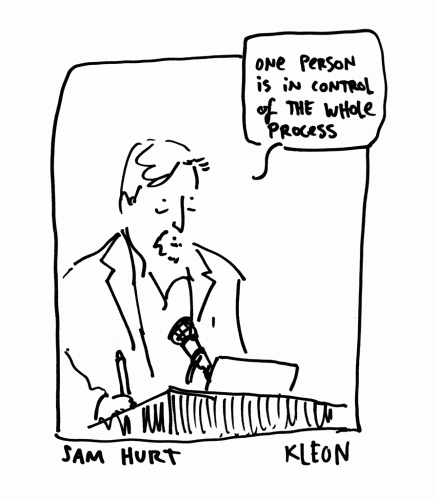
The cartoonist Sam Hurt (Eyebeam) gave a lecture on “Telling Stories in Pictures and Words” before the Crumb/Mouly/Spiegelman event last night.
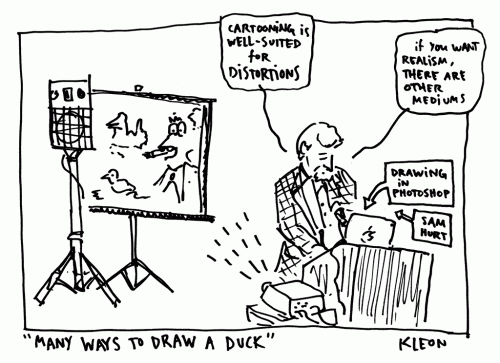
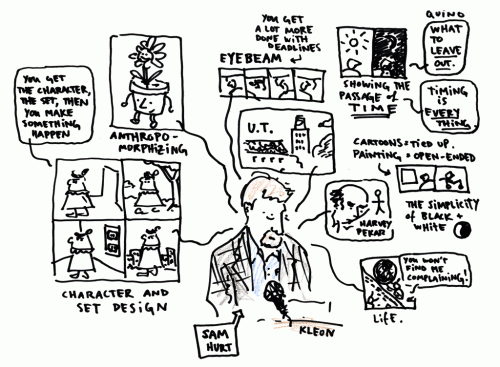
The cartoonist Sam Hurt (Eyebeam) gave a lecture on “Telling Stories in Pictures and Words” before the Crumb/Mouly/Spiegelman event last night.
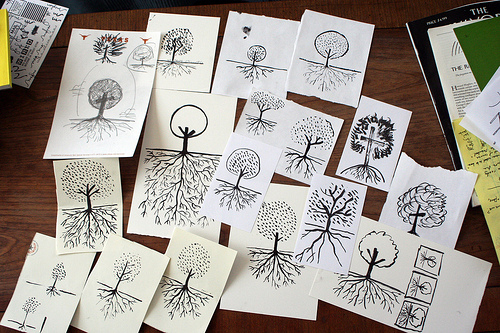
After years of working at a newspaper, my uncle Jeff quit his job to follow his true passion: preaching. My aunt Connie commissioned me to draw him an image of a tree with strong roots for his 50th birthday.
This kind of assignment is rough for me, because I’m not a fine artist. For the kind of drawing and cartooning I practice, drawing isn’t just a drawing, it’s more like picture-writing. It’s about writing with symbols…either conveying some kind of information or telling a story.
The biggest problem was that I was trying to be clever by using a cross for the tree trunk:
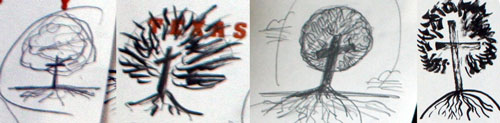
I almost drove myself crazy trying to get it to look recognizable.
And so, after endless drafts, I learned a valuable lesson:
Don’t try to be clever. Just draw.
As Faulkner put it, “Kill your darlings.”
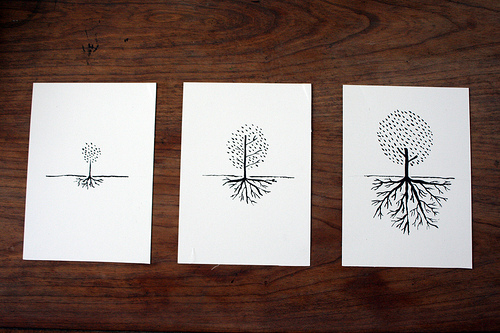
I threw the cross idea out the window, and went with what I love to do: tell a story in a series of simple pictures.
The bonus of all this was that the tree I drew as the “final” in the series turned out to be the best one I came up with:
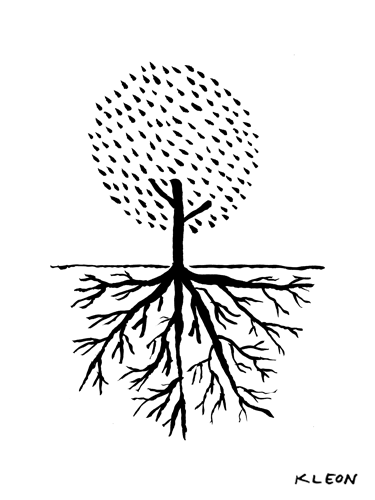
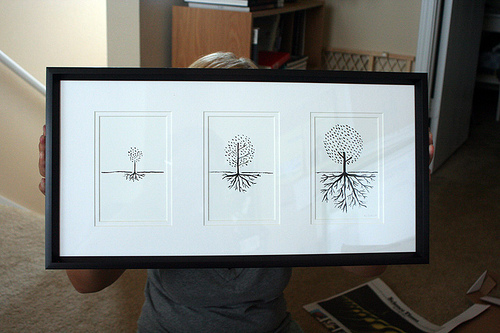
So Meg and I headed off and got a three-panel frame:
Voila! A tree triptych.
A couple of days later, I learned another valuable lesson: Do some research.
Had I been more thorough with my Googling, I might have found Bruno Munari’s book, Drawing A Tree:
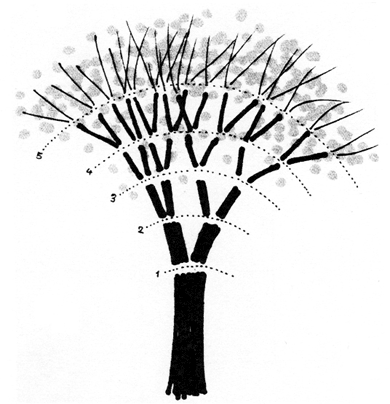
A tree is a slow explosion of a seed….When drawing a tree, always remember that every branch is more slender than the one that came before. Also note that the trunk splits into two branches, then those branches split in two, then those in two, and so on, and so on, until you have a full tree, be it straight, squiggly, curved up, curved down, or bent sideways by the wind.
You draw, you learn.
So-called creative people understand better than most that there is nothing new under the sun. Working with boulders of granite, with empty stages, with blank paper, they are credited with making something out of nothing, but that isn’t exactly what they do. All art is derived from what is in actuality a remarkably finite human experience. Whatever the medium, the creative person’s task is to interpret an essentially unchanging reality, a dog-eared reality pondered by Homer and Mel Brooks and everyone in between. The artist succeeds if he or she can present something familiar from an unfamiliar angle.”
— Rheta Grimsley Johnson
While everyone else is reading David Michaelis’s new biography, Schulz and Peanuts, I’ve decided to wait and ask for it for Christmas. Instead, I’m reading Rheta Grimsley Johnson’s underrated and unfortunately out-of-print 1989 “authorized” biography, Good Grief: The Story of Charles M. Schulz. People have called the book “innocuous” and “flattering”, but I think it deals with Schulz’s depression in a very straightforward and explicit manner, and the writing is really great. Worth tracking down.
Chapter 6 of the book is dedicated to Schulz’s “12 devices”—the twelve ideas that Schulz considered essential to the success of Peanuts:
1. The Kite-eating tree.

2. Schroeder’s music
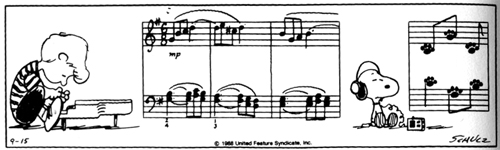
I was looking through this book on music, and it showed a portion of Beethoven’s Ninth in it, so I drew a cartoon of Charlie Brown singing this. I thought it looked kind of neat, showing these complicated notes coming out of the mouth of this comic-strip character, and I thought about it some more, and then I thought, ‘Why not have one of the little kids play a toy piano?’
—Schulz
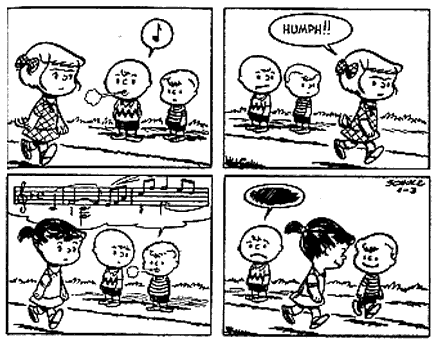
3. Linus’s blanket
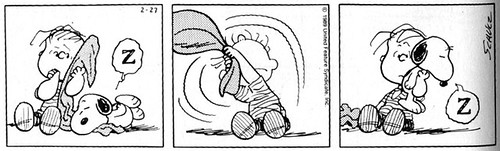
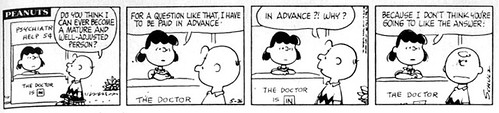
4. Lucy’s psychiatry booth
5. Snoopy’s doghouse
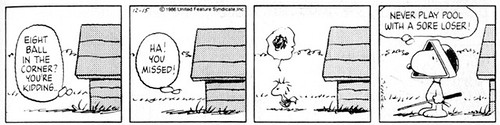
In the beginning, Snoopy actually slept in his doghouse, and a three-quarter view that worked in perspective was the readers’ most familiar angle….The emergence of Snoopy’s doghouse as Grand Device centered not on actual depictions of the humble abode but on allusions to its fantastic contents…the only view the reader is ever given is a left side view. Yet as its graphic depiction became severely restricted, its function became limitless.
—R.G.J.
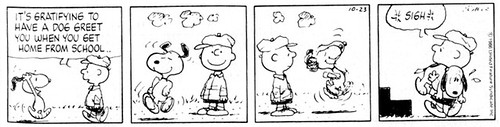
6. Snoopy himself
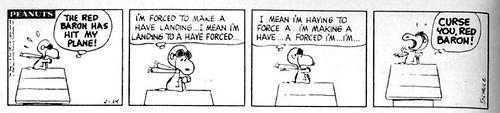
7. The Red Baron
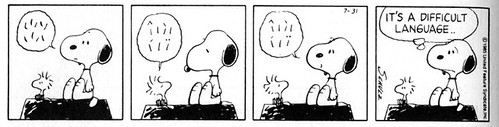
8. Woodstock
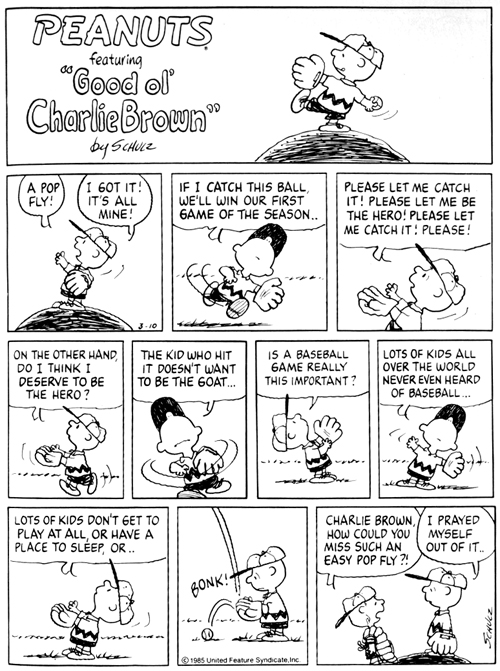
9. The baseball games
10. The football episodes
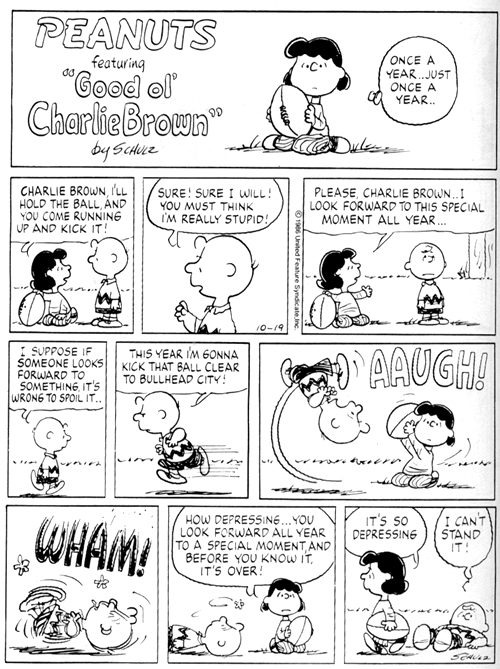
Besides losing, the running (and falling) gag is a pure example of another element that has worked so well for Schulz: repetition…Nothing else in Peanuts is so mechanically repetitious as the football joke….One newspaper editor canceled Peanuts, complaining that the author did the same things over and over. He was forced to reinstate the comic strip, with an apology, when his readers set up a postal howl.
—R.G.J.
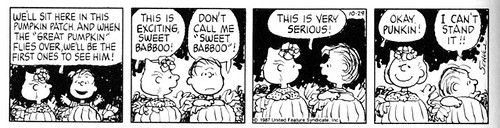
11. The Great Pumpkin
12. The little red-haired girl
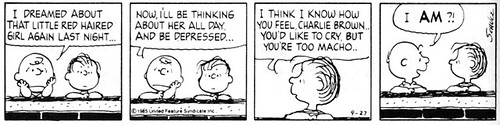
Hank Williams’s plaintive ballad “I Can’t Help It If I’m Still In Love With You” spurred the inclusion of the little red-haired girl in Peanuts. After listening to the song over and over again, Schulz was inspired to include in his cast of characters the unrequiting lover….The littler red-haired girl has never been depicted…and he believes she never will be.
—R.G.J.
On cartooning and design:
Good cartoon drawing is good design. A lot of people aren’t aware of that.
On the skills of a cartoonist:
Schulz: I have a combination of strange abilities I can draw pretty well, and i can write pretty well, and i can create pretty well, but I could never be an illustrator. It doesn’t interest me.
Rose: That’s because the idea doesn’t come from you?
Schulz: [Yes.]
On humor and sadness:
I suppose there’s a melancholy feeling in a lot of cartoonists, because cartooning, like all other humor, comes from bad things happening. People will say, “Well why don’t you have Charlie Brown kick the football?” And I say, “Well, that would be wonderful, it’s happy, but happiness is not funny.” I wish we could all be happy, but it isn’t funny.
On autobiography:
Schulz: All of the things that you see in the strip, if you were to read it every day and study it, you would know me.
Rose: To read your characters is to know you.
Schulz: Isn’t that depressing?
From the sketchbook of Adrian Tomine:
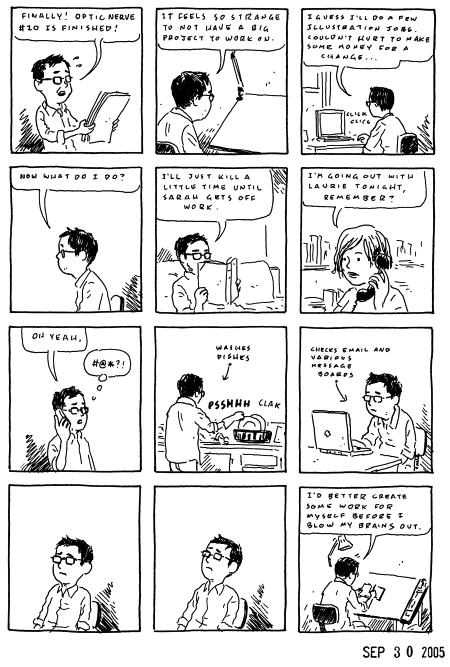
Mark pointed out this great excerpt from an interview with Tomine:
I went out to dinner with my wife at a sushi place in Brooklyn. Right as we were seated at our table, the couple at the adjacent table begins the following exchange:
WOMAN: So, did you read that book I gave you?
MAN: Which one?
WOMAN: The comic. Summer Blonde.
MAN: Oh, yeah. I hated it.
My wife and I locked eyes, like we couldn’t believe this was really happening. We sat there in silence, fakely looking through our menus while the guy proceeded to just eviscerate me in way that was not only cruel but also quite insightful and intelligent. The woman started to get kind of defensive, and she said, “Well, I don’t know. I thought the stories had kind of a nice poetic touch to them.” And that just set the guy off even further. He starts ranting, “No, no…you see? You’re falling for his bullshit! It’s not poetic! It’s like…he’s trying to seem poetic without really saying anything at all!”
I was absolutely paralyzed, and my wife couldn’t take it anymore. She asked the waitress to move us to another seat. They moved us to the sushi bar, but even from there, we could still hear snippets of the guy’s tirade. In particular, I remember hearing him say, “Oh, you must be joking. That was absolutely the worst story in the whole book!” When the couple finished their dinner and got up to leave, my wife started rising from her seat, apparently to give the guy “a piece of her mind.” I had to beg and plead and eventually physically restrain her from saying anything to him. The timing and coincidence of it all seems too implausible to believe, but I swear it’s true, and as far as I know, not some kind of elaborate prank.
Hysterical. Here’s another interview with The Believer.
This site participates in the Amazon Affiliates program, the proceeds of which keep it free for anyone to read.