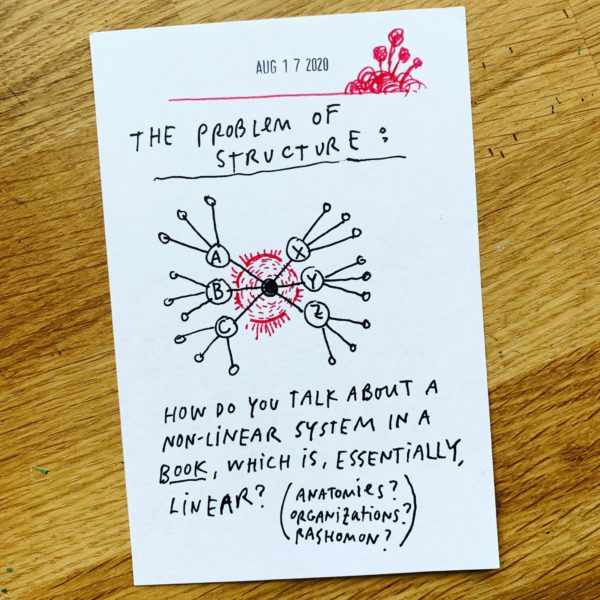
The other day I was noodling on this notecard, thinking about how I would go about structuring a book based on a kind of non-linear system in which all the pieces needed to work together, and I asked Twitter and Instagram, “What book do you love that has an unusual but brilliant structure?”
I got hundreds of responses, mostly fiction. (Pamela Colloff noticed this right away and asked for non-fiction recommendations, starting another great thread.) Many weren’t really what I was looking for — lots of people recommended the Choose Your Own Adventure books or Mark Danielewski’s House of Leaves or Chris Ware’s Building Stories, which are all brilliant in their own ways, but I was mostly interested in non-fiction that reads like a linear book, but has a structure that is weird but brilliantly maps to the subject matter.
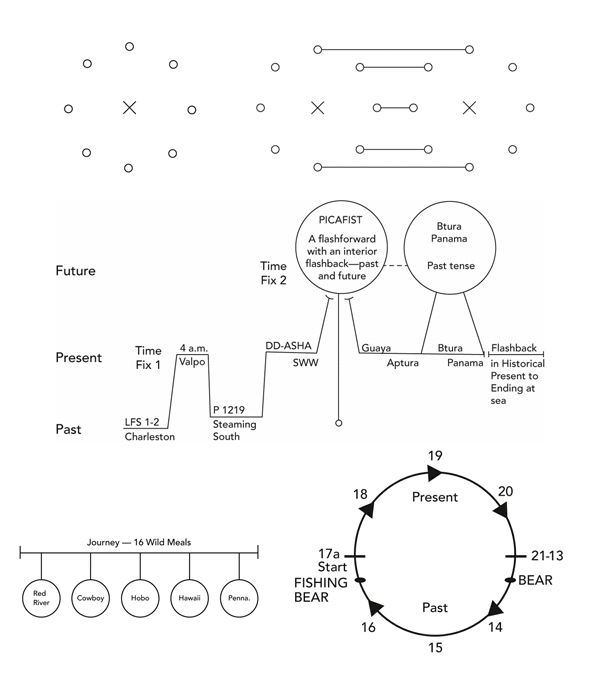
There’s John McPhee, of course, the master, who learned to diagram structure from his English teacher, and shares many of his “inscrutable blueprints” in his book on writing, Draft. No. 4.
A new-to-me book I picked up immediately was Jane Alison’s Meander, Spiral, Explode: Design and Pattern in Narrative.
One of my very favorite writers, Sam Anderson (author of Boom Town), gave his list, which reminded me I still need to read Sei Shonagon’s The Pillow Book (I recently read two other works of Zuihitsu, Essays in Idleness and Hojoki), Anne Carson (Nox and others), and Annie Dillard. (My youngest loved The Monster at the End of This Book.)
Recent non-fiction mentioned that caught my eye: Isabel Wilkerson’s The Warmth of Other Suns, Lewis Hyde’s A Primer for Forgetting, Sarah M. Broom’s The Yellow House, and Carmen Maria Machado’s In The Dream House.
Fiction mentioned that I’ve been meaning to read for years: Tristram Shandy and The Rings of Saturn.
Old favorites mentioned: Richard McGuire’s Here, Christopher Alexander’s A Pattern Language, Alan Fletcher’s The Art of Looking Sideways, and the fragmented collage-like books of Maggie Nelson (The Argonauts) and Sarah Manguso (Ongoingness.)
One intriguing recommendation: Emerson’s essays, like “Circles,” which the recommender claimed could be read out of order, by paragraphs or sentences. (I’ve been meaning to read more Emerson after my year of Thoreau.)
You can poke through more of the recommendations, here, here, and here.
Happy reading!