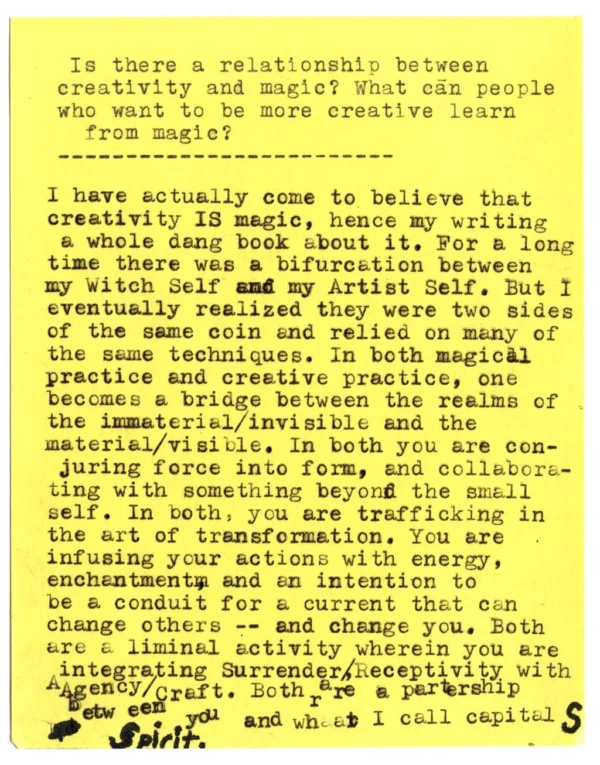
Here is the first question from my typewriter interview with Pam Grossman.
Here is the first question from my typewriter interview with Pam Grossman.
“The machine doesn’t write the music. You tell the machine what to do and the machine is an extension of you.”
—Laurie Spiegel“We are playing the machines, the machines play us.”
—Kraftwerk
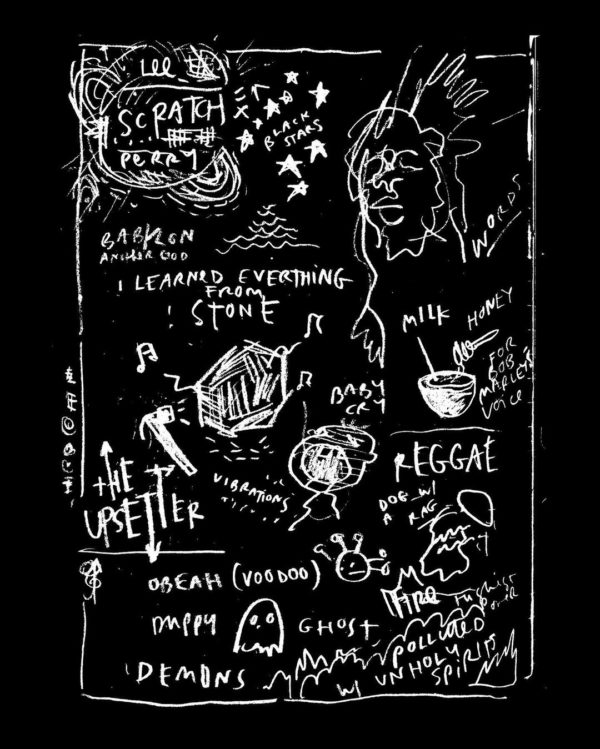
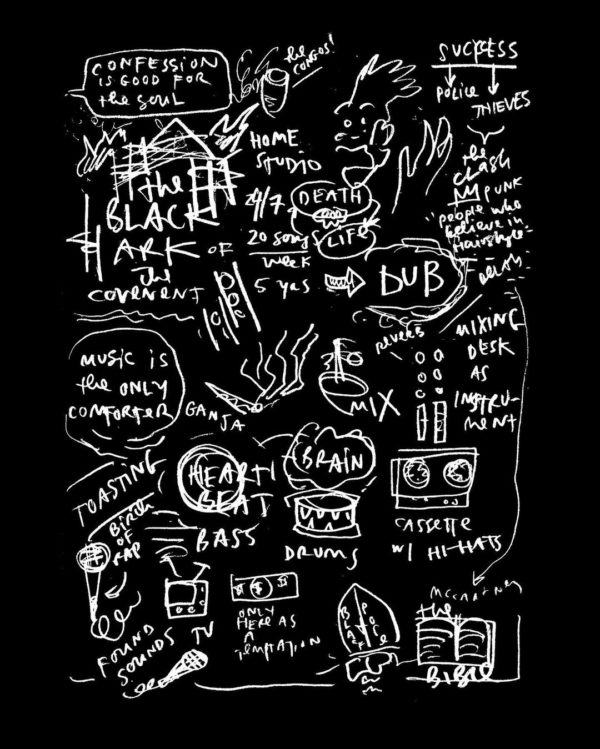
RIP Lee “Scratch” Perry. Here are some doodles I drew while watching The Upsetter: The Life and Music of Lee Scratch Perry.
Most of my favorite music that he produced — stuff like Super Ape and The Heart of the Congos — was made in his home studio — the “Black Ark” — with “just a four-track quarter-inch TEAC reel-to-reel, 16-track Soundcraft board, Mutron phase, and Roland Space Echo.” As has been noted by so many, he played the studio itself like an instrument:
I see the studio must be like a living thing, a life itself. The machine must be live and intelligent. Then I put my mind into the machine and the machine perform reality. Invisible thought waves – you put them into the machine by sending them through the controls and the knobs or you jack it into the jack panel. The jack panel is the brain itself, so you got to patch up the brain and make the brain a living man, that the brain can take what you sending into it and live.
In this amazing clip from the 1977 documentary Roots, Rock, Reggae: Inside the Jamaican Music Scene, you can see him at work in his prime:
https://www.youtube.com/watch?v=y651C7aNXRc
Perry would do all kinds of weird stuff to get wild sounds into the music — to inject some sort of aliveness into his machines, to mix the organic into the synthetic — stuff like burying a microphone under a palm tree and beating it for a bass drum. Wikipedia:
He would often “bless” his recording equipment with mystical invocations, blow ganja smoke onto his tapes while recording, bury unprotected tapes in the soil outside of his studio, and surround himself with burning candles and incense, whose wax and dust remnants were allowed to infest his electronic recording equipment. He would also spray tapes with a variety of fluids, including urine, blood and whisky, ostensibly to enhance their spiritual properties. Later commentators have drawn a direct relationship between the decay of Perry’s facility and the unique sounds he was able to create from his studio equipment.
I don’t even know what the digital equivalent would be — opening music files in a text editor and inserting gibberish and secret messages to try to glitch the sound?
In his interview with Rick Rubin, Brian Eno, another producer famous for playing the studio like an instrument, spoke of being interested in that area between what humans can do and what machines can do.
The machines, without us, are without soul, but the machines, and our interactions with them, can also help us bring out the soul. There is a sense, at certain moments, that we are not just working in tandem, but the machine is leading us as much as we are leading it…
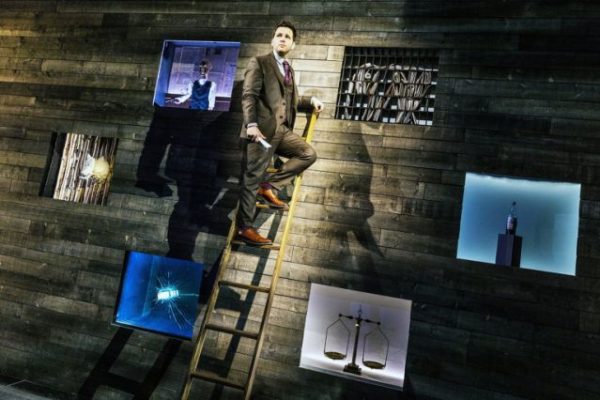
I really liked Derek DelGaudio’s new film directed by Frank Oz, In and Of Itself. (If you haven’t seen it, don’t read anything else about it, just go watch it.) I asked my friend, filmmaker and screenwriter James Francis Flynn, to make me a list of stuff to watch related to magic, illusion, and con artistry. Below is what he sent me.
* * *
The Prestige
DelGaudio was a consultant on this 2006 Christopher Nolan film about rival stage magicians in turn of the century London.
Deceptive Practice: The Mysteries and Mentors of Ricky Jay
A 2012 documentary about Ricky Jay, the famed magician, author, and historian, and those who inspired him to take up those trades.
Ricky Jay and His 52 Assistants
A filmed stage show of Jay’s incredible sleight-of-hand work, directed by David Mamet.
House of Games
David Mamet’s directorial debut, which follows a successful author who becomes drawn into the underground world of card cheats and con artists.
The Sting
During The Great Depression, two professional grifters, played by Paul Newman and Robert Redford, plot to rip off a Chicago mob boss.
An Honest Liar
2014 documentary about James Randi, magician and professional skeptic who made it his life’s work to expose pseudoscientists, psychics, and fakes of all kinds.
Penn & Teller: Bullshit!
Showtime series wherein the magic duo often exposed cold readers, quacks, and scammers. As Penn said in the first episode, “Sure, we lie, cheat, and swindle; we’ve been known to deal in a bit of bullshit ourselves…One important difference: We tell you we’re lying.”
* * *
 James Francis Flynn was born and raised in Oxford, Ohio. I met him when we were students at the Western College Program at Miami University. James currently works in TV and film and lives in Los Angeles with his wife and kids. Check out his latest short film, Social Distancing in Los Angeles, and his website: jamesfrancisflynn.com.
All grownup craft depends on sustaining a frozen moment from childhood: scientists, it’s said, are forever four years old, wide-eyed and self-centered; writers are forever eight, over-aware and indignant. The magician is a permanent pre-adolescent. At least, all lives of magicians begin with a 12-year-old…—Adam Gopnik
Adam Gopnik has a great article in the March 17th New Yorker called “The Real Work: Modern magic and the meaning of life.” It examines the intellectual side of magic: what magic is and what it’s about. No doubt because Gopnik is a writer and former art critic, I found that things he writes about magic have great relevance to the other arts, especially writing.
Quoting Jamy Ian Swiss on distractions:
Magic only ‘happens’ in a spectator’s mind….Everything else is a distraction. Magic talk on the Internet is a distraction. Magic contests are a distraction. Magic organizations are a distraction. The latest advertisement, the latest trick—distractions. Methods for their own sake are a distraction. You cannot cross over into the world of magic until you put everything else aside and behind you—including your own desires and needs—and focus on bringing an experience to the audience. This is magic. Nothing else.
On technique & transparency:
…the magician is one of the few true artists left on earth, for whom the mastery of technique means more than anything that might be gained by it. He center-deals but makes no money—doesn’t even win prestige points—because nobody knows he’s doing it.
…a magician’s technique must be invisible; if it became visible, we would be insulted by its obviousness. Magic is possible because magicians are smart. And what they’re smart about is mainly how dumb we are, how limited in vision, how narrow in imagination, how resourceless in conjecture, how routinized in our theories of the world, how deadened to possibility. The magician awakens us from the dogmatic slumbers of our daily life…
Quoting Teller on irony:
Magic is the most intrinsically ironic of all the arts…I don’t know what your definition of irony is, but mine is something where, when you are seeing it, you see it in two different and even contradictory ways at the same time. And with magic what you see collides with what you know. That’s why magic, even when merely executed, ends up having intellectual content. It’s intrinsic to the form.
Quoting Teller on illusion:
There’s a moment in your life when you realize the difference between illusion and reality and that you’re being lied to….Santa Claus. The Easter Bunny. After my mother told me that there was no Santa Claus, I made up an entirely fictitious girl in my classroom and told my mother stories about her….If you’re sufficiently preoccupied with the power of a lie, a falsehood, an illusion, you remain interested in magic tricks.
It’s a long piece, and there are lots of other great bits. The article isn’t online, but you can listen to a good 15-minute podcast where he discusses it on the New Yorker site.
Related links:

[Teller’s] definition of magic: “The theatrical linking of a cause with an effect that has no basis in physical reality, but that — in our hearts — ought to.”
The Science Times ran a great article on magic, perception and consciousness today, and with it came this cool photo set of Teller demonstrating a coin trick. It reminded me of the wonderful third chapter in Edward Tufte’s Visual Explanations — co-written with professional magician Jamy Ian Swiss — “Explaining Magic: Pictorial Instuctions and Disinformation Design,” that examines illustrations like this:
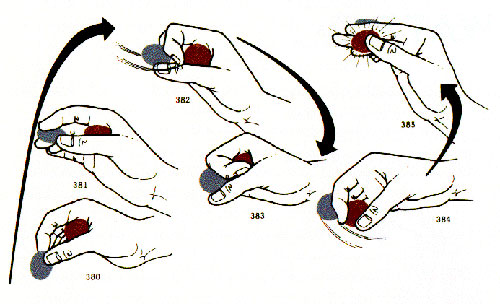
Page 60:
In a difficult manipulation, the magician’s hands quickly exchange a silver coin for a copper one. Timing is crucial in magic, and the complex and rapid performance required for deft conjuring is not easy to illustrate. For this sleight, the author notes that the swift moves “must be done in a one-two-three up and down wave of your hand.” Depicting the action at a rate of two frames per beat, the multiple images flow over time and through space, just as a statistical graph records a time-series… Heavy arrows conduct the rhythm of images, while streamers in frames 382 and 384 indicate finer movements of fingers and coins. In this trick, like many others, small maneuvers of fingers are masked by larger hand movements. To expose the method, these drawings depict the hand tipped at varying angles toward the reader. Yet a slightly different angle of adjustment will assure that the audience sees only a silver coin magically transformed into a copper coin. Magicians are preoccupied with such viewing angles, which make the difference between a successful deception and a disastrous exposure. And so for illustrators: Are readers to see the produced effect or how to produce the effect, or both, and by means of what angles?
Speaking of Tufte, I was trolling one of my favorite sites, Peter Durand’s Center for Graphic Facilitation, and came across his notes from one of Tufte’s seminars:
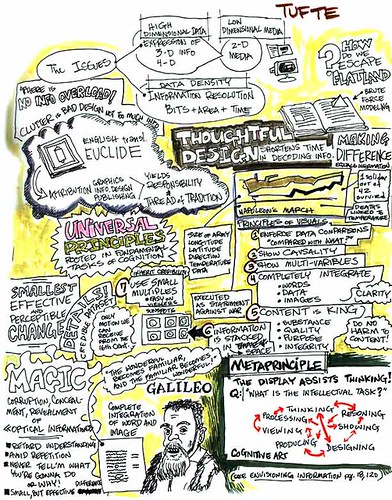
Regular blog readers know how fond I am of mind-mapping Tufte: see Beautiful Evidence, Envisioning Information, and my thoughts on the relationship between comics and information design.
This site participates in the Amazon Affiliates program, the proceeds of which keep it free for anyone to read.