Steal Like An Artist: The Book

BLOG ARCHIVES

Posts Tagged ‘handwriting’


How to improve your handwriting

Wednesday, May 23rd, 2012

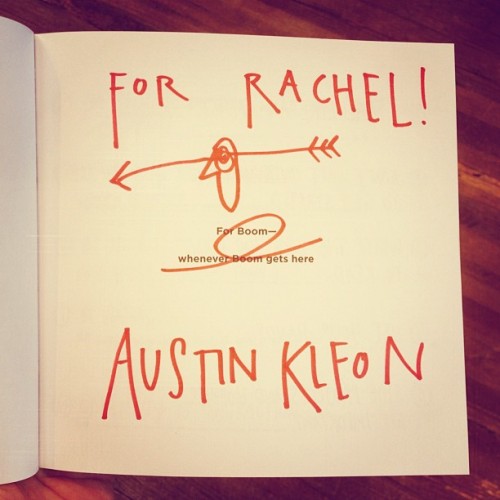
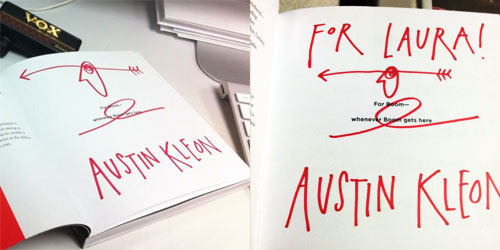
Signed copy of STEAL

signed copies of steal

I love, love, love signing books. I’m used to people saying, “I wish I could draw,” but there have been a surprising number of folks on this tour who remark on my handwriting. Sometimes people just like it, and sometimes people are really surprised that it’s the same handwriting that’s in the book. (A lot of people think that the writing in the book is a font.)

The underlying notion here is that handwriting is somehow magical, that you’re just naturally gifted with lovely penmanship. But as I explain to folks on tour, just as I learned to draw by copying Garfield cartoons, I learned to write by copying other people’s handwriting.

My first two handwriting heroes were Phil Collins and John Lennon:
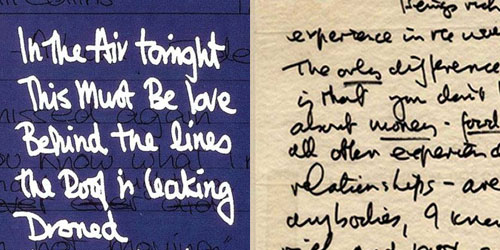
Phil Collins and John Lennon Handwriting

I spent hours copying their handwriting, and when I found Jimi Hendrix’s handwriting, I spent hours copying him, too:
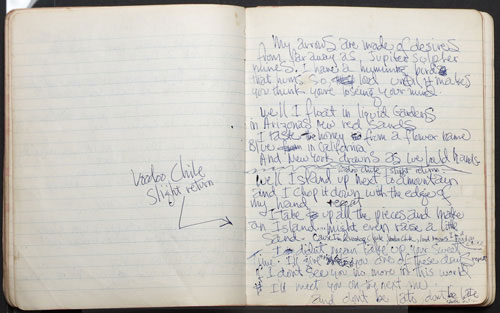
Jimi Hendrix

And in my later life, some of my favorite artists have been obsessed with handwriting. Lynda Barry practices the alphabet with her brush everyday as a way to get warmed up. You can see little alphabets pop up in her drawings:
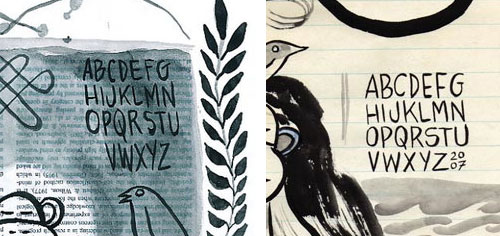
Lynda Barry alphabet

The handwriting in Steal is my attempt to rip off Maira Kalman and Steve Brodner:
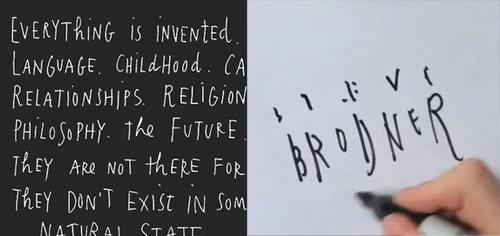
Maira Kalman and Steve Brodner

As Lynda says, “In the digital age, don’t forget to use your digits!” There some studies that suggest handwriting boosts the brain and that handwriting helps you learn. It’s a damned shame penmanship isn’t taught more in school.

Anyways, the point is: handwriting, drawing…it’s all marks on the page. The way towards better handwriting is explained in chapter two of Steal: start copying. To paraphrase Jack Kirby, if you like the way a man writes, steal his hand. Copy him. As you’re copying his writing, the copy will mutate, and you’ll find your own hand.

For more on handwriting, check out my “handwriting” tumblr tag→
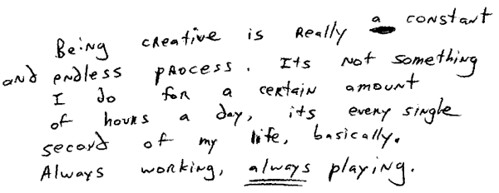
ALWAYS WORKING, ALWAYS PLAYING

Thursday, September 6th, 2007

Words from James Kochalka, courtesy of Dan Stafford’s hand-written interviews with cartoonists:

Here’s a cool post from Tom Kealey about writing and the importance of play.

OUR WAY OF BEING IN THE WORLD: ZADIE SMITH ON WRITING AND PERSONALITY

Friday, June 1st, 2007

A writer’s personality is his manner of being in the world: his writing style is the unavoidable trace of that manner. When you understand style in these terms, you don’t think of it as merely a matter of fanciful syntax, or as the flamboyant icing atop a plain literary cake, nor as the uncontrollable result of some mysterious velocity coiled within language itself. Rather, you see style as a personal necessity, as the only possible expression of a particular human consciousness. Style is a writer’s way of telling the truth. Literary success or failure, by this measure, depends not only on the refinement of words on a page, but in the refinement of a consciousness, what Aristotle called the education of the emotions.”

- Zadie Smith, “Fail Better***

Now THAT’S something they don’t teach you in creative writing class. That YOU might have to actually work on YOURSELF instead of your writing…

Style is a trace of the writer’s personality.

And writing with pictures is no different. In fact, I feel that the personality of style is even easier to detect in cartoonists, probably because what you’re seeing in the cartoonist’s art is the actual marks of his or her hand. (Anybody up for some handwriting analysis?) Think of it: R. Crumb. Lynda Barry. James Kochalka. Charles Schulz. Personalities inked all over the page.

This is why I return to people’s writing and writing with pictures: to read what they have to say. To soak up their manner of being in the world. Like Smith, this is also why I write. “When I write I am trying to express my way of being in the world.”

But what IS this way of being? What is personality? Smith says it’s much more than autobiographical detail, “it’s our way of processing the world, our way of being, and it cannot be artificially removed from our activities.” It’s about perspective, not autiobiography — not necessarily what you’ve seen, but how you’ve seen it.

It’s also about what we read and what allies we choose to make. “The choices a writer makes within a tradition – preferring Milton to Moliere, caring for Barth over Barthelme – constitute some of the most personal information we can have about him.” It’s about what we weed out of our brains and our souls: “a process of elimination.”

[O]nce you have removed all the dead language, the second-hand dogma, the truths that are not your own but other people’s, the mottos, the slogans, the out-and-out lies of your nation, the myths of your historical moment – once you have removed all that warps experience into a shape you do not recognise and do not believe in – what you are left with is something approximating the truth of your own conception. That is what I am looking for when I read a novel; one person’s truth as far as it can be rendered through language.”

Reading, looking, writing, and drawing–you do it all at the same time, and slowly chisel yourself out of a big block of DNA. You gotta work on YOURSELF, along with your writing. This is something that doesn’t fly in your typical workshop. Craft might not be “the enemy,” as James Kochalka says, but it certainly ain’t the whole picture, either.

[W]riting is the craft that defies craftsmanship: craftsmanship alone will not make a novel great. This is hard for young writers…to grasp at first. A skilled cabinet-maker will make good cabinets, and a skilled cobbler will mend your shoes, but skilled writers very rarely write good books and almost never write great ones. There is a rogue element somewhere – for convenience’s sake we’ll call it the self, although, in less metaphysically challenged times, the “soul” would have done just as well. In our public literary conversations we are squeamish about the connection between selves and novels. We are repelled by the idea that writing fiction might be, among other things, a question of character. We like to think of fiction as the playground of language, independent of its originator….Though we rarely say it publicly, we know that our fictions are not as disconnected from our selves as you like to imagine and we like to pretend. It is this intimate side of literary failure that is so interesting; the ways in which writers fail on their own terms: private, difficult to express, easy to ridicule, completely unsuited for either the regulatory atmosphere of reviews or the objective interrogation of seminars, and yet, despite all this, true.”

Unfortunately, I have no link to the full text of Smith’s article. I was going through my desk at work today and found an old printout of it covered with highlighter from some lunch in the breakroom, and I was about to toss it until I realized the Guardian doesn’t make it available online anymore. It ran in two parts, beginning on Saturday, January 13th, 2007. I remember it making the blog rounds, but somehow, I never commented on it. Link to the article.