Screenshots of Despair
Wednesday, September 26th, 2012
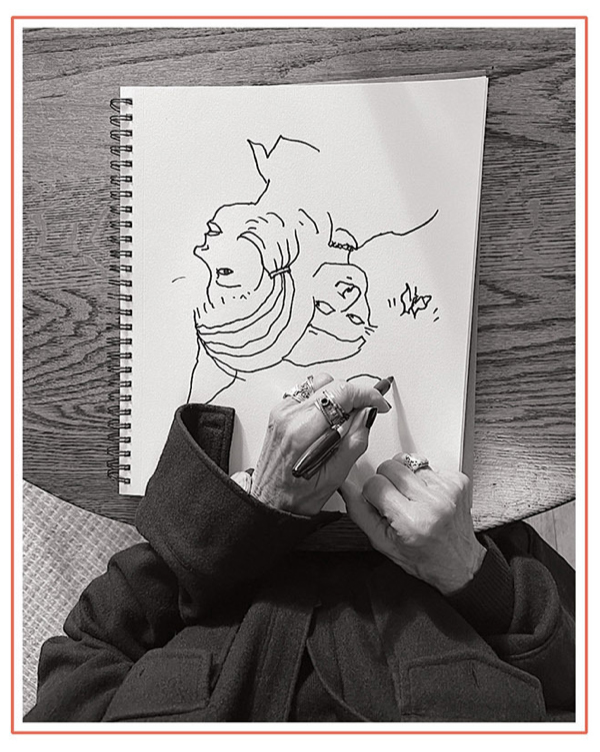
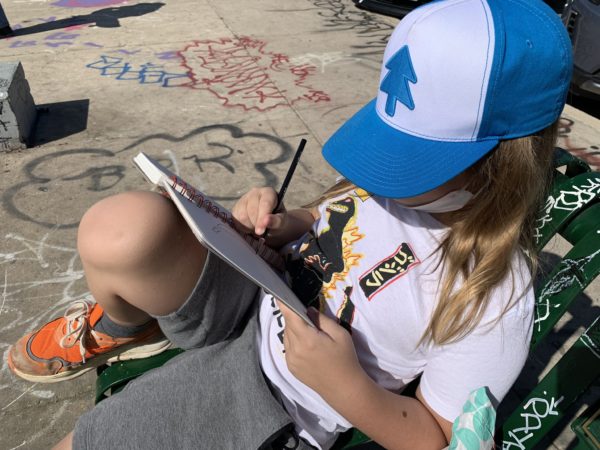
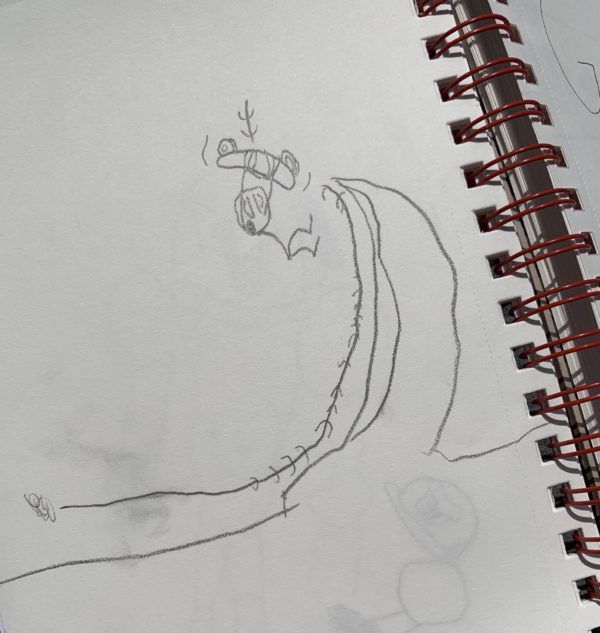
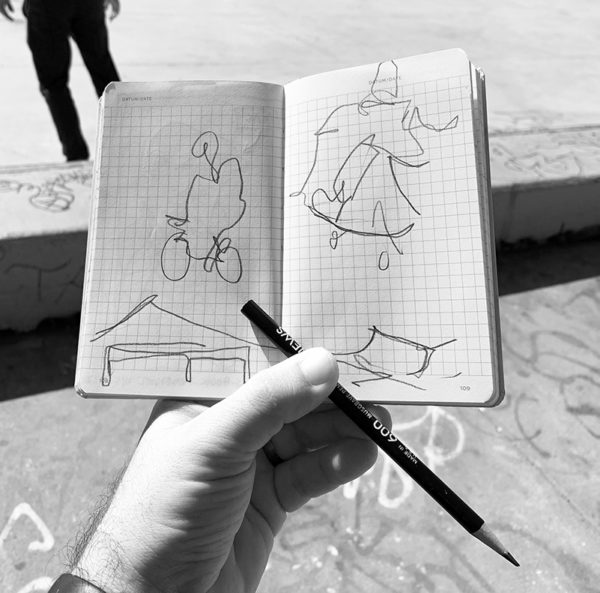
This morning to warm up I drew some entries from one of my favorite Tumblrs, Screenshots of Despair.


This morning to warm up I drew some entries from one of my favorite Tumblrs, Screenshots of Despair.


Here I am modeling my new favorite t-shirt:
Designed by Kyle Fletcher of Mutual Midwest and screen printed by our friends at the one and only Wire&Twine, this 5-color design features every illustration in Ed Emberley’s classic drawing book, “Make a World”. From dump truck to schooner, from forklift to dinosaur, every image is on the shirt.
Go here and buy one to support the production of the upcoming documentary, Ed Emberley’s Make A World: The Film.
I only came to Ed Emberley’s Ed Emberley’s Drawing Book: Make A World last year, but it’s quickly become the #1 book I recommend to people I meet who say, “I can’t draw.” In it, Ed Emberley shows you how to “make a world” with just a few simple shapes, step-by-step. I love the emphasis on simplicity: if you can draw a triangle, a square, a circle, and a line, you’re good to go.
(Here’s a great little video review of the book by Chris Glass.)
And yeah, I have sat down with the book and copied all the exercises!
Shot this little video at lunch on my Iphone and posted it to Twitter. I came up with the little exercise for my Vizthink Viznotes webinar. Folks seemed to dig it, so I’m posting it here.
The Iphone continues to inspire me with possibilities. Ideas spread to a thousand people…instantly.
Instant publication.
The best part of all? It can be quick and dirty. People forgive quality. Heck, they’re probably watching the thing on their phone…so why not shoot it on your phone?
After years of working at a newspaper, my uncle Jeff quit his job to follow his true passion: preaching. My aunt Connie commissioned me to draw him an image of a tree with strong roots for his 50th birthday.
This kind of assignment is rough for me, because I’m not a fine artist. For the kind of drawing and cartooning I practice, drawing isn’t just a drawing, it’s more like picture-writing. It’s about writing with symbols…either conveying some kind of information or telling a story.
The biggest problem was that I was trying to be clever by using a cross for the tree trunk:

I almost drove myself crazy trying to get it to look recognizable.
And so, after endless drafts, I learned a valuable lesson:
Don’t try to be clever. Just draw.
As Faulkner put it, “Kill your darlings.”
I threw the cross idea out the window, and went with what I love to do: tell a story in a series of simple pictures.
The bonus of all this was that the tree I drew as the “final” in the series turned out to be the best one I came up with:

So Meg and I headed off and got a three-panel frame:
Voila! A tree triptych.
A couple of days later, I learned another valuable lesson: Do some research.
Had I been more thorough with my Googling, I might have found Bruno Munari’s book, Drawing A Tree:

A tree is a slow explosion of a seed….When drawing a tree, always remember that every branch is more slender than the one that came before. Also note that the trunk splits into two branches, then those branches split in two, then those in two, and so on, and so on, until you have a full tree, be it straight, squiggly, curved up, curved down, or bent sideways by the wind.
You draw, you learn.

For this second batch of tea bag doodles, I merged a little activity I stole from Dave Gray via Bill Keaggy with another activity I stole from Matt Madden’s blog.
Here’s the drill:

Like I said before: nothing serious, just a fun way to pass a couple minutes and find some ideas.


This last card I used to take notes on an article about how language shapes the way we think:

Leonardo da Vinci used to suggest that art students “look at any walls spotted with various stains,” so as to “arouse the mind to various inventions.” Sandro Botticelli liked to throw a sponge wet with colored paints against a wall, then search out new landscapes in the resulting splatter.—Lewis Hyde, Trickster Makes This World
This is a fun little cubicle Rorschach activity that I ripped off of Dave Gray. I found it while reading through Bill Keaggy‘s “100 Pieces of Paper and The Stories Behind Them.”
I switched from coffee to tea at work, so every morning I take an index card and set my tea bag down on it, letting the card soak up the tea. Then, I shop for images on the card, and riff off those with some doodles and captions.
Nothing serious, just fun way to pass a couple minutes and find some ideas. You could probably do it with coffee rings, too. They’d be like little ensos.
Windsor McCay on cartooning:
“Start drawing and do not stop – draw everything you see, no matter how badly…Every drawing you make is better than the one you made before. Don’t take yourself seriously—nor your drawing. The drawing you think is good to-day may turn out to-morrow to be so badly done you will be ashamed of yourself for showing it yesterday. You should never be satisfied….WORK! WORK! That’s all there is to cartooning.”
Advice from Frank King in the 1926 book HOW TO DRAW CARTOONS by Clare Briggs:
“There is one thing I tell students who want advice about cartooning; that is, to carry a paper pad and a pencil and make sketches of everything—people in every attitude, chairs, animals, boats, buildings, automobiles—literally everything. Make hundreds and thousands of them. It will help in every way when they get to doing cartoons. If persisted in they can build a fine foundation for any sort of cartooning they undertake. The beginners will find themselves becoming skillful at suggesting a face or an attitude directly and simply. They will forget all the sketches of things they have made, but they will find many of them coming back when they need them. Get some fun out of it and the beginner improves rapidly.My advice to the beginner or the advanced student—sketch everything in sight.”
The drawing skills don’t matter. It’s can you get down on paper what’s in your head? And if you can in such a way that when I read it you’re opening up a new eye to the world for me or a new ear to the how people talk, or what have you…then it’s cookin’. It’s comics. And that’s all that matters.”
- Steve Bissette, from the really great little trailer for Tara Wray’s documentary, “Cartoon College”

Really awesome article this morning in the NY Times about artist William Utermohlen, who after being diagnosed with Alzheimer’s Disease, began drawing/painting self-portraits. The self-portraits, viewed in chronological order, reveal the gradual deterioration of his mind and spirit.
Because Alzheimer affects the “right parietal lobe,” it gets harder and harder to visualize an image and be able to draw it. Art by Alzheimer’s patients becomes “more abstract, the images are blurrier and vague, more surrealistic” and “sometimes there’s use of beautiful, subtle color.”
Looking at these two pieces shoots cold lightning down my spine. It’s so hard to admit to yourself that something you think you do with your heart and soul is really just a bunch of wires connecting your hand to your brain. Maybe it’s for that reason that I find Alzheimer’s to be the most terrifying disease out there.
We’re machines, and machines break down.
I’m also wondering if this Chris Ware quote has any significance:
I see the black outlines of cartoons as visual approximations of the way we remember general ideas, and I try to use naturalistic color underneath them to simultaneously suggest a perceptual experience, which I think is more or less the way we actually experience the world as adults; we don’t really “see” anymore after a certain age, we spend our time naming and categorizing and identifying and figuring how everything all fits together.
And I hate to quote Franzen, but he what about this:
Scott McCloud, in his cartoon treatise “Understanding Comics,” argues that the image you have of yourself when you’re conversing is very different from your image of the person you’re conversing with. Your interlocutor may produce universal smiles and universal frowns, and they may help you to identify with him emotionally, but he also has a particular nose and particular skin and particular hair that continually remind you that he’s an Other. The image you have of your own face, by contrast, is highly cartoonish. When you feel yourself smile, you imagine a cartoon of smiling, not the complete skin-and-nose-and-hair package.
Even towards the end of his abilities, Utermohlen could still make a circle, two dots, and a horizontal line.
Even if it was the face of a ghost, it was still a face.